Abstract
In November 1918, Max von Baden's cabinet appointed Matthias
Erzberger (1875-1921) – then an undersecretary of state without
portfolio – to head the German delegation charged with concluding an
armistice with the Entente Powers. He signed the agreement in this
capacity on November 11, 1918. Over the next few months, he served first
as armistice commissioner and then as minister without portfolio
(responsible for armistice issues). In the National Assembly, Erzberger
managed to convince the Catholic Center Party to offer its overwhelming
support for the Versailles Treaty, which was by no means a given. From
June 1919 to March 1920, he served as Reich Finance Minister. Although
he managed to push through fundamental financial and tax reforms, he had
to contend with massive and growing right-wing agitation against his
person. As the initiator of the Reichstag Peace Resolution, a signatory
of the Armistice, an advocate of the Versailles Treaty, and a visible
public figure in the Weimar democracy, he was a highly charged negative
symbol for right-wing nationalists. On August 26, 1921, Erzberger was
assassinated by nationalist extremists.
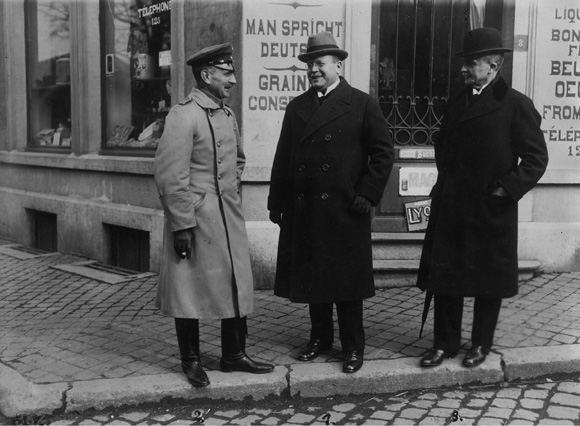
The photograph shows Matthias Erzberger (center) with General von
Hammerstein-Gesmold (left) and Undersecretary Ernst von
Langwerth-Simmern (right) in Spa, Belgium.