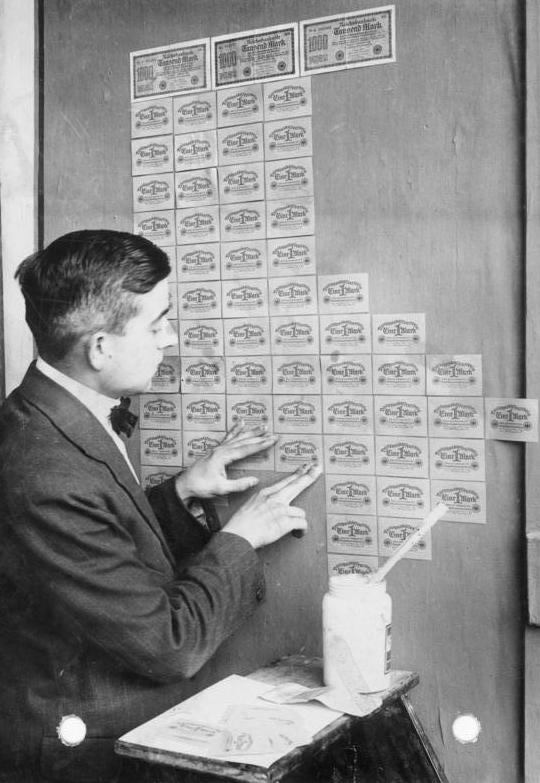
Abstract
With the onset of hyperinflation in the summer of 1922, Germany’s
economic situation went from bad to worse. In January 1923, French and
Belgian troops occupied the Ruhr in an effort to force Germany to meet
its reparations obligations. The German government declared a policy of
passive resistance. It subsidized enterprises, owners, and workers,
exacerbating the hyperinflation even as the Ruhr’s industrial economy
ground to a halt. The government had neither the gold reserves nor the
real economic production needed to meet its obligations. But it did have
printing presses, which it used with abandon. Paper notes became
worthless as soon as they were printed. On November 2, 1923, the
Reichsbank issued the first 100-trillion-mark note. By the end of the
month, 1 U.S. dollar was worth 4.2
trillion marks.