Abstract
When the sailors revolted at the beginning of November 1918, workers'
and soldiers' councils formed in many German cities. In the eyes of
these groups, the imperial government had forfeited their legitimacy.
Now the workers' and soldiers' councils would assume some of the
government's most important functions: above all securing public safety
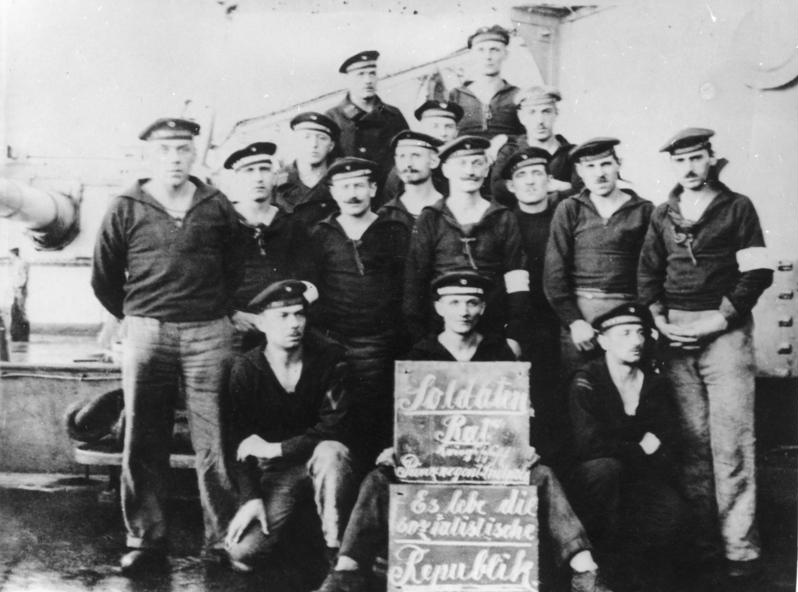
and mitigating inadequate food supplies. This photograph shows the
soldiers' council of the Battleship Prince Regent Luitpold's crew. The
sign they are displaying reads, "Soldiers' Council of the
Battleship Prince Regent Luitpold. Long live the socialist
republic!" These words capture how soldiers' councils hoped for the
establishment of a socialist council republic following the Russian
example. (The German word for council,
Rat, is usually translated into
English with the Russian "soviet.")
Food shortages and poor treatment had already led the ship's crew to
mutiny in August 1917. That was put down by force and two sailors were
executed. As a condition of the armistice of November 11, 1918, this
warship was interned by the British at Scapa Flow and sunk by its crew
on June 21, 1919.