Abstract
According to the Treaty of Versailles, the German army was to be
reduced to 100,000 professional soldiers and the Freikorps disbanded.
Accordingly, hatred of the government that had signed the treaty
smoldered among both officers and soldiers. The Freikorps, in
particular, which Reichswehr Minister Noske had deployed shortly
beforehand to crush radical left-wing revolutionaries, opposed its
dissolution. They included the openly anti-republican naval brigade
under the command of Corvette Captain Hermann Ehrhardt, which consisted
of around 5,000 soldiers who wore swastikas on their steel helmets and
refused to fly the flag of the republic. Noske ordered its dissolution
on February 29, 1920, but General Walther von Lüttwitz (1859-1942),
General of the Reichswehr Group Command, defied the order. He also
refused to support the government, demanded the immediate dissolution of
the National Assembly and new elections as well as his appointment as
commander-in-chief of the Reichswehr. When the Reichswehr refused to act
against the anti-government troops in the event of a putsch, Ebert
decided to leave for Dresden with the majority of his cabinet. On the
morning of March 13, shortly after the government had left the capital,
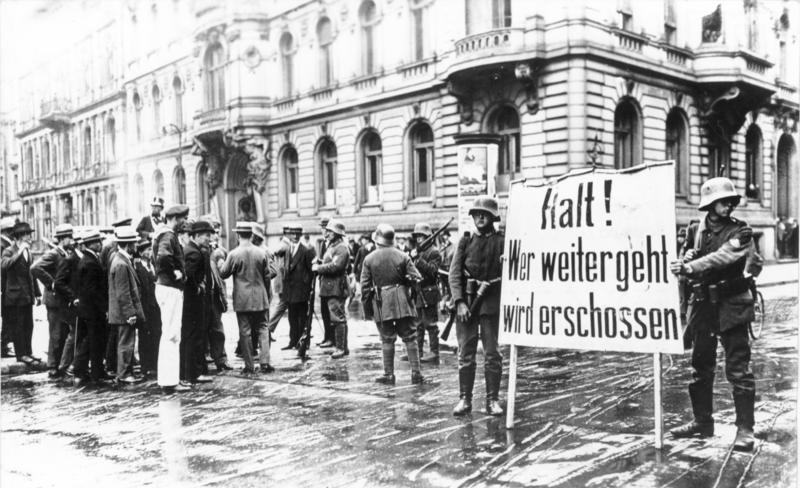
the Ehrhardt Marine Brigade marched into Berlin and occupied the
government district. Wolfgang Kapp (1868-1922), the East Prussian
right-wing conservative leader of the German National People's Party
(DNVP), declared the government deposed and appointed himself the new
Reich Chancellor. He appointed his co-conspirator Lüttwitz as Reichswehr
Minister and Commander-in-Chief. General Erich Ludendorff was one of the
high-ranking military officers who supported the coup. However, the coup
failed due to the opposition of the Berlin ministry officials on the one
hand, who remained loyal to the legitimate government, and that of the
workers on the other, as the trade unions called a general strike and
thus paralyzed the city. On March 15, traffic and public life in Berlin
came to a standstill, and electricity, gas and water lines were out of
order. The Reichsbank also refused to make payments to the putschists.
On March 17, the putschists capitulated, Kapp and Lüttwitz resigned and
then went abroad. Only one of the putschists, Traugott von Jagelow, who
was appointed Minister of the Interior by Kapp, later had to stand trial
and was released from prison after a few years. The trade unions, which
had gained political self-confidence through their decisive role in
thwarting the putsch, demanded the resignation of Gustav Noske as
Reichswehr Minister, as he had failed to put a stop to the reactionary
tendencies within the Reichswehr. On March 22, Friedrich Ebert resigned
and was replaced by Otto Geßler (DDP). In addition, General Hans von
Seeckt became the new head of the army command.