Source
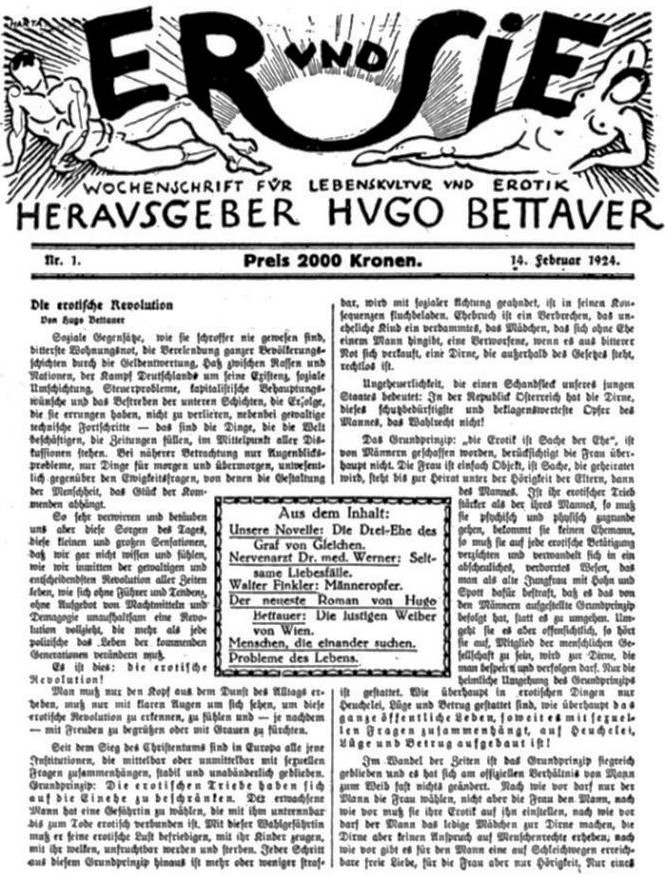
The Erotic Revolution
Social contradictions have never been sharper, the direst housing shortage, the impoverishment of entire social strata through monetary devaluation, hate between races and nations, Germany’s struggle for existence, social upheaval, tax pogroms, capitalist self-assertion and the strivings of the lower classes not to lose what they have gained, and, meanwhile, tremendous technological progress—these are the things that occupy the world, that fill the newspapers, that are the center of all discussions. Upon closer inspection they are only transitory problems, merely affairs of tomorrow and the day after, inessential compared to the eternal questions on which the development of humanity and the happiness of the coming generations depend.
So confused and benumbed are we by these daily concerns, these minor and major sensations, that we utterly fail to realize, to feel, that we are living in the midst of the most powerful and fateful revolutions of all time. Without leaders and partisan debates, without the exertion of force and demagogy, a revolution is pursuing its inexorable course, which, more than the political one, will necessarily change the lives of those to come.
It is the erotic revolution!
[…]
Since the triumph of Christianity all the institutions in Europe that dealt directly or indirectly with sexual questions have remained stable and unchanged. Their fundamental principle: the erotic drives had to be restrained to only what was necessary. The adult male was to choose his life companion, who was to remain erotically linked with him until death. With this chosen companion he was to satisfy his erotic lust, with her he was to conceive children, wither, become unfruitful, and die. Every departure from this fundamental principle was more or less punishable, avenged by social ostracism, and accursed in its consequences. Adultery was a crime, the illegitimate child condemned, the girl who gave herself to a man outside of wedlock despised, or, when bitter need arose, the whore existed outside the law and without rights.
[…]
The fundamental principle, that the erotic belongs to marriage, was created by men and takes no consideration of the woman. The woman is simply an object, a thing to marry; she exists up until marriage in subjection to the parents, then to the husband. If her erotic drive is stronger than her husband’s, then she necessarily goes psychologically and physically to ruin; if she fails to find a husband, she is deprived of all erotic activity and turns into a horrid, withered being suffering scorn and ridicule as an old virgin because she followed the fundamental principle established by men instead of circumventing it. If, however, she circumvents it in public, then she ceases being a member of society, becomes a whore whom people are allowed to spit upon and persecute. Only a clandestine circumvention of the fundamental principle is allowed. As in erotic matters altogether, only hypocrisy, lies, and betrayal are permitted, as the whole of public life, insofar as sexual questions are concerned, is built upon hypocrisy, lies, and betrayal.
In changing times the fundamental principal has remained triumphant, and officially the relationship between man and woman has scarcely changed. As always, the man is allowed to choose the woman, but the woman cannot choose the man; as always she must adapt her erotic nature to his; as always, the man is allowed to turn the single woman into a whore, with the whore having no claim to human rights; as always, the man has access to free love through secret means whereas for the woman there is only subjection. Only one thing has changed, and that fundamentally: with the advancing industrialization of the world the woman has been dragged out of the harem, the bower, the woman’s quarters, the weaving, sewing, and children’s rooms and into life, into the factory, the sweatshop, and the office. And, in unavoidable consequence, the woman could not be deprived of an apparent equality of rights. An apparent one. For if the woman can also ride, drive a car, go out alone, or travel; if she is permitted to become a doctor or legislator; if she is permitted, indeed compelled, to toil and slave like a man, she remains nonetheless his subject, dependent on him in her most exquisite and vitally important functions, and is vilified and condemned if she violates the fundamental principle.
Things are not better now for the woman but worse than they were a hundred years ago. Back then in seclusion she learned contentment and discharged her eroticism as a childbearer. Today she is sexually stimulated, can move around freely for hours in an alcohol and a nicotine haze, but only as far as a clearly drawn limit, a limit drawn by the man for purely egotistical reasons.
[…]
Woman has become a beast of burden, like the man. This has not, however, won her her sexual freedom. […] For the fundamental principle remains in force.
Or remained in force. For the erotic revolution is underway; it is not to be stopped, despite all manner of ostrich policies. For two, perhaps three years now, things erotic are beginning to be rearranged, with the young starting to assail the fundamental principle. The working, producing people have begun, have taken the axe to an ancient system of hypocrisy and duplicity in the creation of which the name of the savior was misused. Whoever has open eyes, whoever is not so dumb as to believe that the occupation of the Ruhr and “broadcasting” are the most important things in the world, can see how the erotic revolution advances day by day. The erotic revolution that wants to create free, happy people. For it is simply the case, and no one can change it, that everything existing is based on eroticism, everything that is beautiful, good, and lovely on earth is bound up inseparably with eroticism. The flower in the meadow, the butterfly floating above it, the singing of the birds, the chirping of the crickets, the rustling of the trees, and the ripening of the fruit—erotic symbols, erotic purpose, erotic will. It was reserved to the greed, selfishness, stupidity, and maliciousness of people to brand the god Eros a criminal, to sully erotic play with filth.
This magazine, which has arisen under the sign of the erotic revolution, wants to join the struggle and to speak openly about things that the blinkered philistines continue to pass over. It will not shrink from discussing the most ticklish, delicate problems of life and will not be stopped from revealing open wounds that others want to veil in hypocrisy and lies.
[…]
Source: Hugo Bettauer, “The Erotic Revolution” (1924), in The Weimar Republic Sourcebook, edited by Anton Kaes, Martin Jay, and Edward Dimendberg. © 1994 Regents of the University of California. Published by the University of California Press, pp. 698–700. Reprinted with permission of the University of California Press.
Source of original German text: Hugo Bettauer, “Die erotische Revolution,” Er und Sie. Wochenschrift für Lebenskultur und Erotik 1 (1924), pp. 1–2.