Abstract
Franz von Papen (1879-1969) was a member of the Center party
[Zentrum] and a delegate of the
Prussian state parliament [Landtag].
He belonged to the right, monarchist wing of his party. In June 1932,
Reich President Hindenburg appointed him to succeed Heinrich Brüning as
Reich Chancellor. He essentially owed his appointment to
eminence grise Kurt von Schleicher.
Papen formed a “cabinet of national concentration” made up of
conservative civil servants mostly from the nobility who had no
political mandate. Since the cabinet was not legitimized by a
parliamentary majority, it relied on the Reich President’s support. On
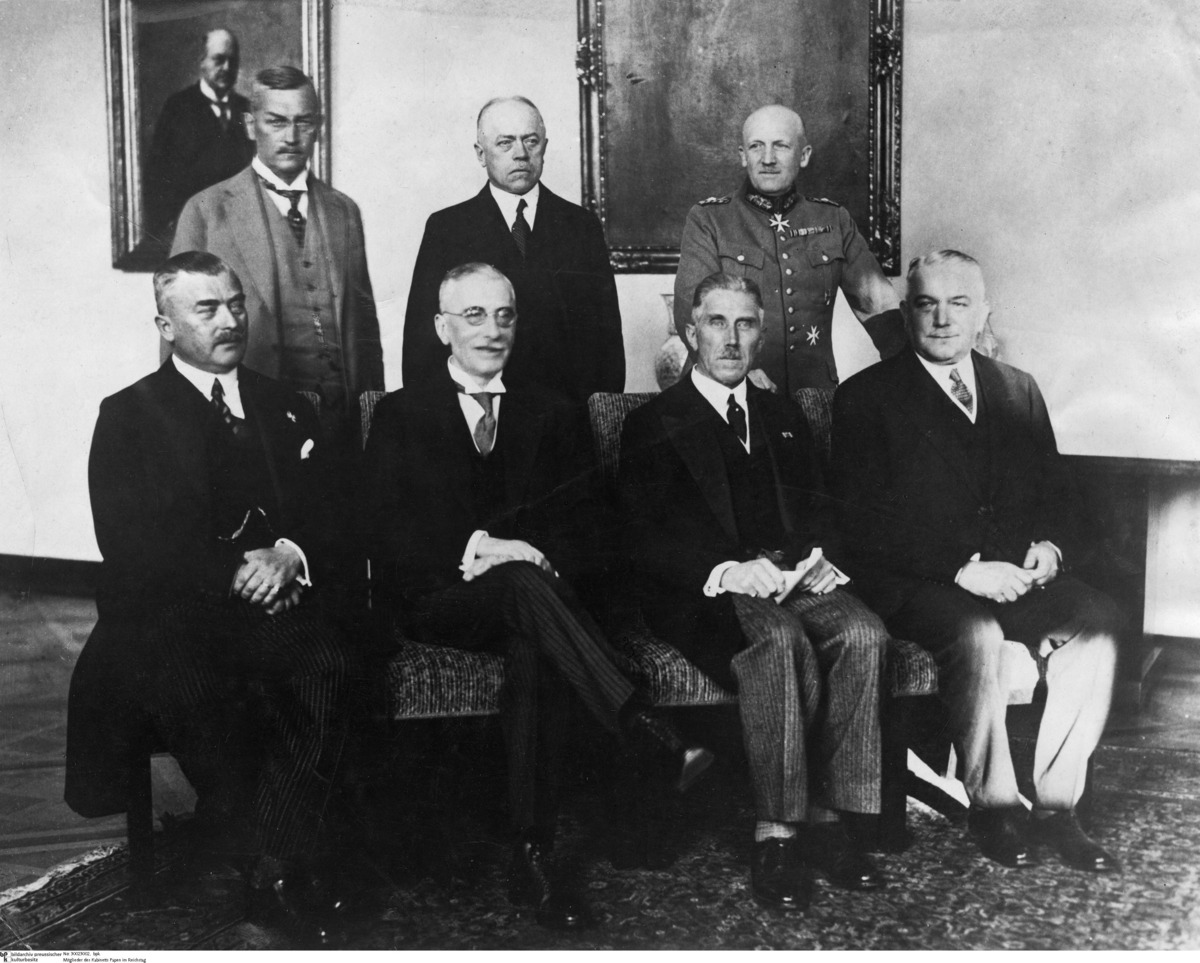
June 3, 1932, the day this photo was taken, Papen left the Center party
in order to preempt his exclusion in disgrace. The following day,
Hindenburg dissolved the Reichstag at Papen’s request, so that he could
govern by means of the Reich President’s right to apply emergency laws
and essentially render parliament powerless. The demise of parliamentary
democracy in Germany had thus been prepared. This photo shows the
members of the Papen cabinet. Sitting from left to right: Magnus von
Braun (Food and Agriculture), Wilhelm von Gayl (Interior), Chancellor
Franz von Papen, Konstantin von Neurath (Foreign). Standing from left to
right: Franz Gürtner (Justice), Hermann Warmbold (Commerce), Kurt von
Schleicher (Army)