Abstract
Bavaria was the first territory in the German Empire in which the
November Revolution ended monarchy. After a peace demonstration in
Munich on November 7, 1918, a group of leftists close to the journalist
and USPD politician Kurt Eisner (1867-1919) ousted Bavarian King Ludwig
III (1845-1921). They sought an immediate end to the war, followed by
the establishment of a parliamentary democracy. Eisner and his followers
proclaimed the Free State of Bavaria, and Eisner was elected
minister-president by a provisional national council, in which workers'
and soldiers' councils were represented. The main goals of the new body
were the preparation of parliamentary elections, support for moderate
peace terms, demobilization, and the improvement of food supplies and
the employment situation. Revolution soon spread from the capital,
Munich, to other industrial centers (Nuremberg, Fürth, Erlangen,
Augsburg, Würzburg). The elections on January 12, 1919, nonetheless
showed that Eisner's provisional government did not have majority
support. Before he could resign on February 21, however, he was
assassinated by a radicalized student with connections to the völkisch,
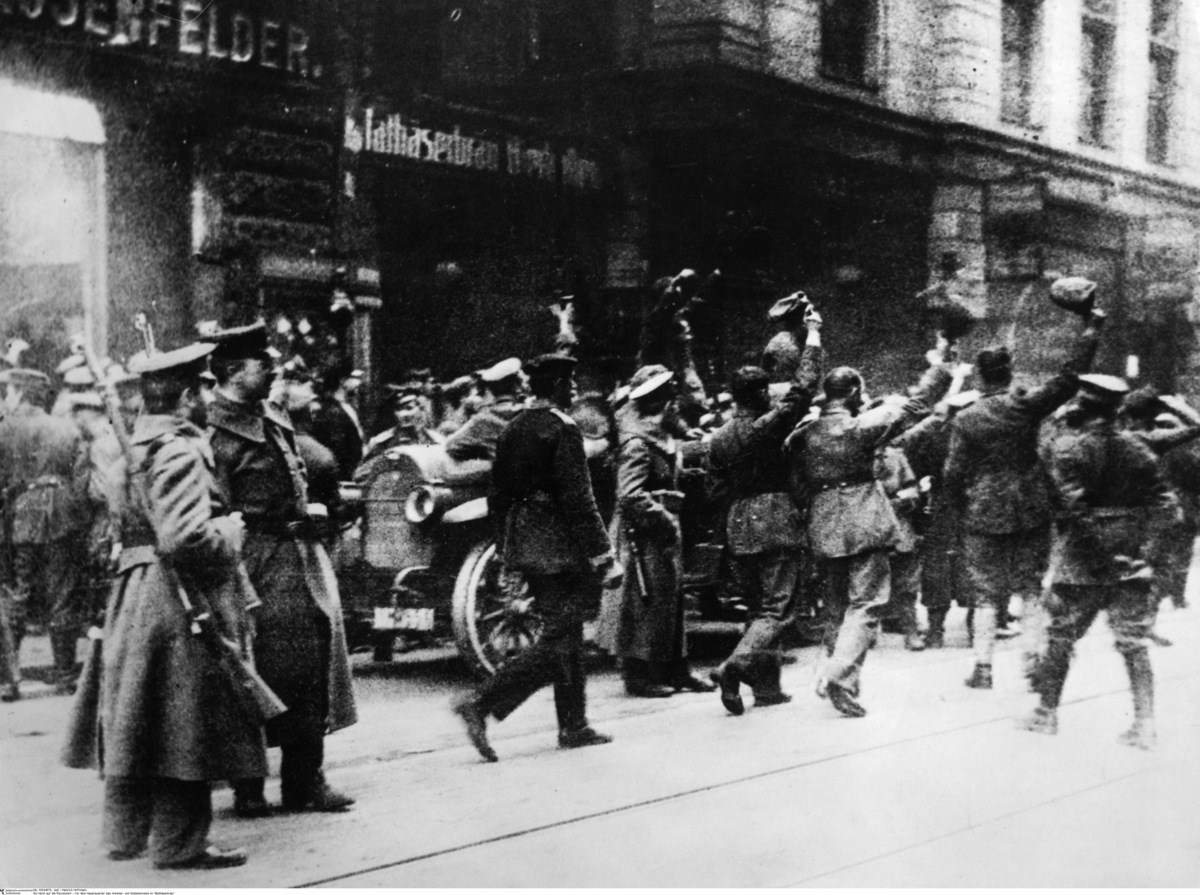
anti-Semitic Thule Society. The photograph, from the November Revolution
some two months earlier, shows cheering soldiers in front of the Munich
pub Mathäserbräu, where the Bavarian Republic was proclaimed. The
photograph was taken by the Munich press photographer Heinrich Hoffmann,
who would become Hitler's personal photographer in the Nazi era.