Abstract
Following the resignation of Reich chancellor Franz von Papen after
the Reichstag elections in November of 1932 because he lacked support in
the Reichstag to form a government, Reich President Paul von Hindenburg
invited the leaders of all the major Weimar parties to Berlin to discuss
the possibility of forming a government. This included Adolf Hitler, who
met Hindenburg for several talks in mid/late November 1932 and declared
that the NSDAP was only prepared to form a government under his
leadership. Hindenburg, in turn, made it clear that he was only prepared
to accept Hitler's chancellorship in a government supported by
parliament, a proposal Hitler rejected. Hindenburg's resistance was
short-lived. After continued political instability and the failure to
form a government under Papen's successor, Kurt von Schleicher,
Hindenburg appointed Adolf Hitler Chancellor on January 30, 1933.
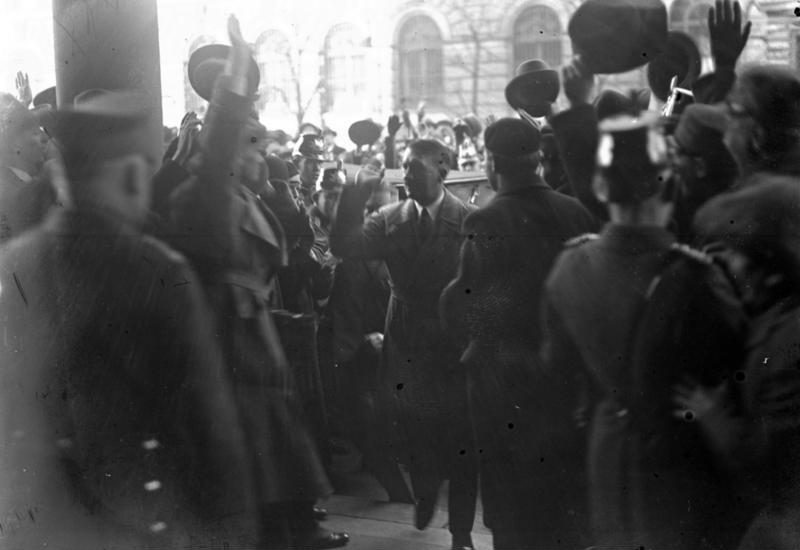
This photo shows the arrival of Adolf Hitler for talks with
Hindenburg in November 1932.
See also the Memorandum from Adolf
Hitler to President Hindenburg via Otto Meissner rejecting Hindenburg's
proposals to form a government, November 24, 1932.