Abstract
The right-wing parties vehemently rejected the Young Plan because
they considered the reparations payments too high and the duration too
long. Since the Weimar Constitution provided the electorate with the
opportunity to directly influence legislation by means of a plebiscite,
the political right decided to initiate a referendum in order to effect
the rejection of the Young Plan. In July 1929, they formed the “Reich
Committee on the Referendum against the Young Plan.” In order to repeal
it, they drafted the so-called “Freedom Law,” which declared all
provisions of the Versailles Treaty invalid and charged the German
signatories of the Young Plan with treason. They hoped the German
electorate would vote for this law in the referendum and thus override
the Young Plan.
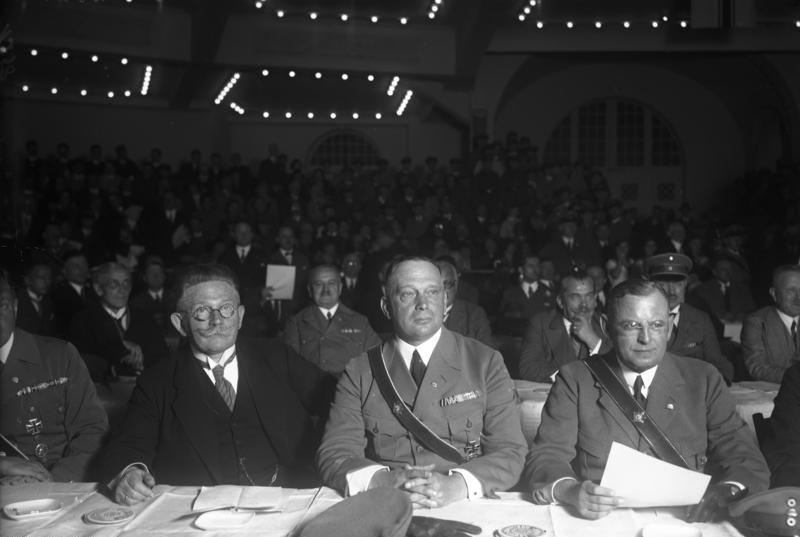
This photo from September 1929 was taken during a propaganda rally
for the referendum at the Berlin
Sportpalast. The photo shows the
executive committee organizing the referendum (from left to right):
Alfred Hugenberg (1865-1951), DNVP chairman and owner of an influential
media business, Franz von Stephani (1876-1939), a
Freikorps leader and head of Berlin’s
Stahlhelm chapter, and Franz Seldte (1882-1947), co-founder of Stahlhelm
and one of its main leaders. A further member of the “Reich Commission,”
Adolf Hitler, is missing from this picture. The referendum was
eventually held on December 22, 1929. Less than 14% of those eligible to
vote in it supported a repeal of the Young Plan; the political right’s
attempt to change the course of the Republic’s foreign policy had
failed. Nevertheless, initiating the referendum meant a political
success for the NSDAP since its cooperation with the more established
DNVP and other nationalist organizations had raised the party’s profile
and popularity, which resulted in a significant gain in votes during the
next elections in 1930.