Abstract
The first Reich President, Friedrich Ebert, died in February 1925,
shortly before the end of his term. Whereas Ebert had been elected by
the National Assembly, his successor was to be chosen through a direct
presidential election. When none of the seven candidates was able to win
an absolute majority in the first ballot, the Weimar coalition
government unified behind Zentrum
party candidate Wilhelm Marx. Meanwhile, the right-wing parties
nominated the seventy-eight-year-old, unaffiliated General Paul von
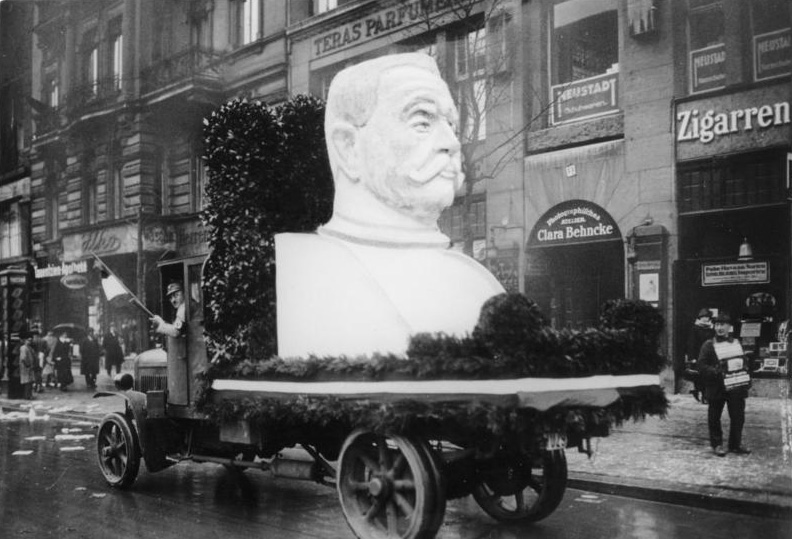
Hindenburg, who narrowly won in the second ballot. This photograph shows
a truck campaigning for Hindenburg in the streets of Berlin. The truck
carries an oversized bust of Hindenburg, around whom a powerful
militarist cult of personality developed. That Hindenburg was perceived
as the “Victor of Tannenberg” certainly played an important part in his
unexpected victory. Hindenburg, who continued to openly express
monarchist convictions after the revolution, took the oath of office and
swore on the Weimar Constitution. During his first term, he disappointed
the political right, who had hoped to bring the republic to a swift
end.