Abstract
In December 1918, the German People’s Party (DVP) was formed as a
merger of the National Liberal Party’s
[Nationalliberale] right wing led by
Gustav Stresemann (1878-1929) and the Progressive Party
[Fortschrittliche Partei]. The DVP
agenda consisted primarily in fighting both Social Democrats and
Communists, and, as a result, opposition to the SPD-led government was
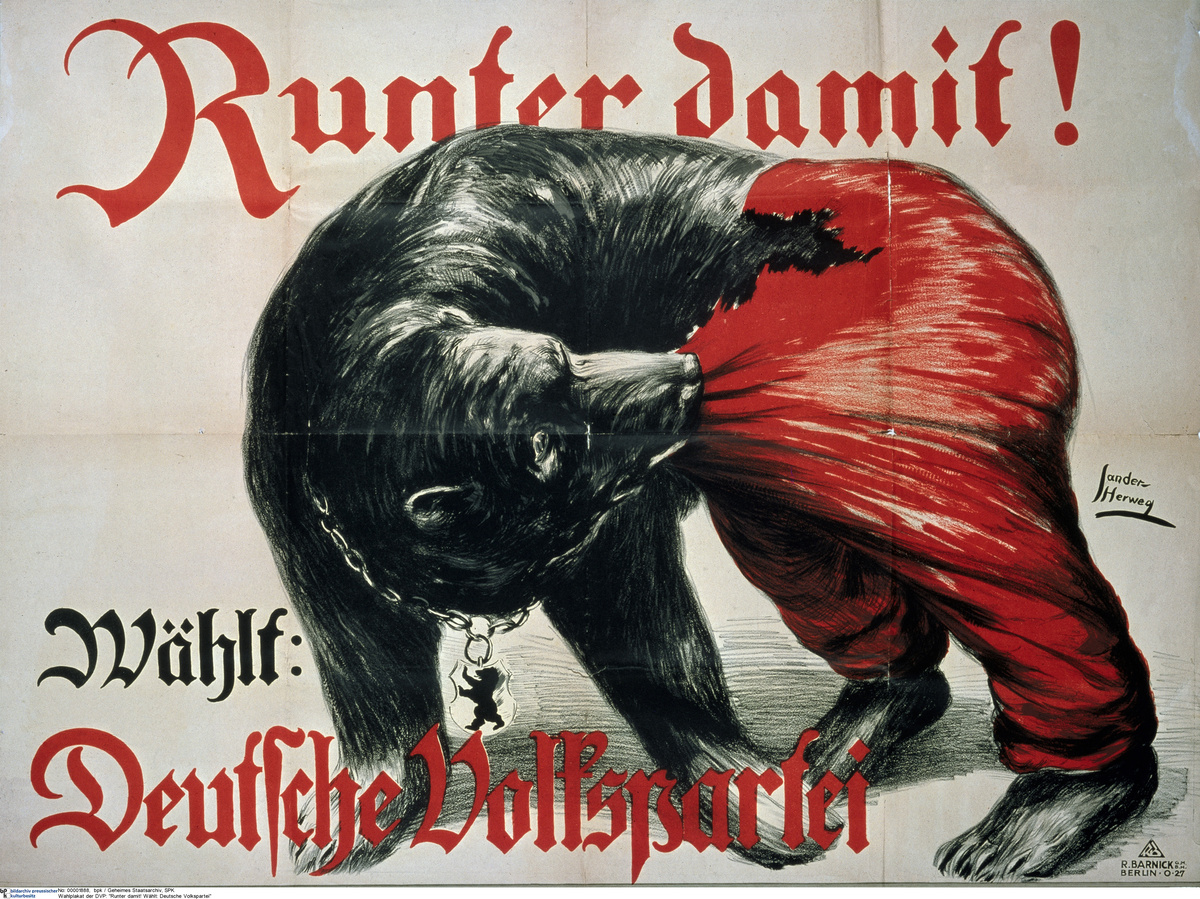
the primary focus of its election campaigns. This election poster serves
as an example. The Berlin Bear representing the capital is portrayed as
freeing himself from the Social Democrat-dominated government by tearing
off a pair of symbolically red pants. The poster reads: “Off with it!
Vote for: Deutsche Volkspartei.” This campaign poster was created for
the Reichstag elections of May 1924, in which the DVP and other parties
representing the bourgeoisie lost a significant number of seats, while
the SPD once again emerged as the strongest party. Although the DVP
initially rejected the parliamentary republic and aimed for a
reinstatement of the monarchy, it became part of the government
coalition in 1920 and, under the leadership of Stresemann, began to
reconcile itself with the republic. Within the DVP, which received
substantial financial support from leading industrialists, the right
wing never lost influence, however. Since Stresemann’s cooperation with
the SPD met with disapproval among these circles, a large number of
those party members joined more extreme right-wing parties, such as the
DNVP or the NSDAP.