Abstract
After successful ceasefire agreements with Austria-Hungary (November
3, 1918) and the German Reich (November 11, 1918), the victorious powers
Great Britain, France, Italy, and the United States summoned all
countries that had taken part in the war to the Paris Peace Conference.
From January 18, 1919, until January 21, 1920, a total of 32 states
debated the conditions for peace that should be set for the German Reich
and its allies. At the forefront were reparations payments and
territorial settlements that would restore Europe’s pre-war boundaries.
Taking President Wilson’s Fourteen Points as a starting point, the
Entente and the defeated Central Powers signed five separate treaties,
each of which was negotiated in a different Paris suburb: the Versailles
Treaty for the German Reich, as well as the Treaties of Saint-Germain,
Neuilly, Trianon, and Sèvres for Austria, Bulgaria, Hungary, and Turkey,
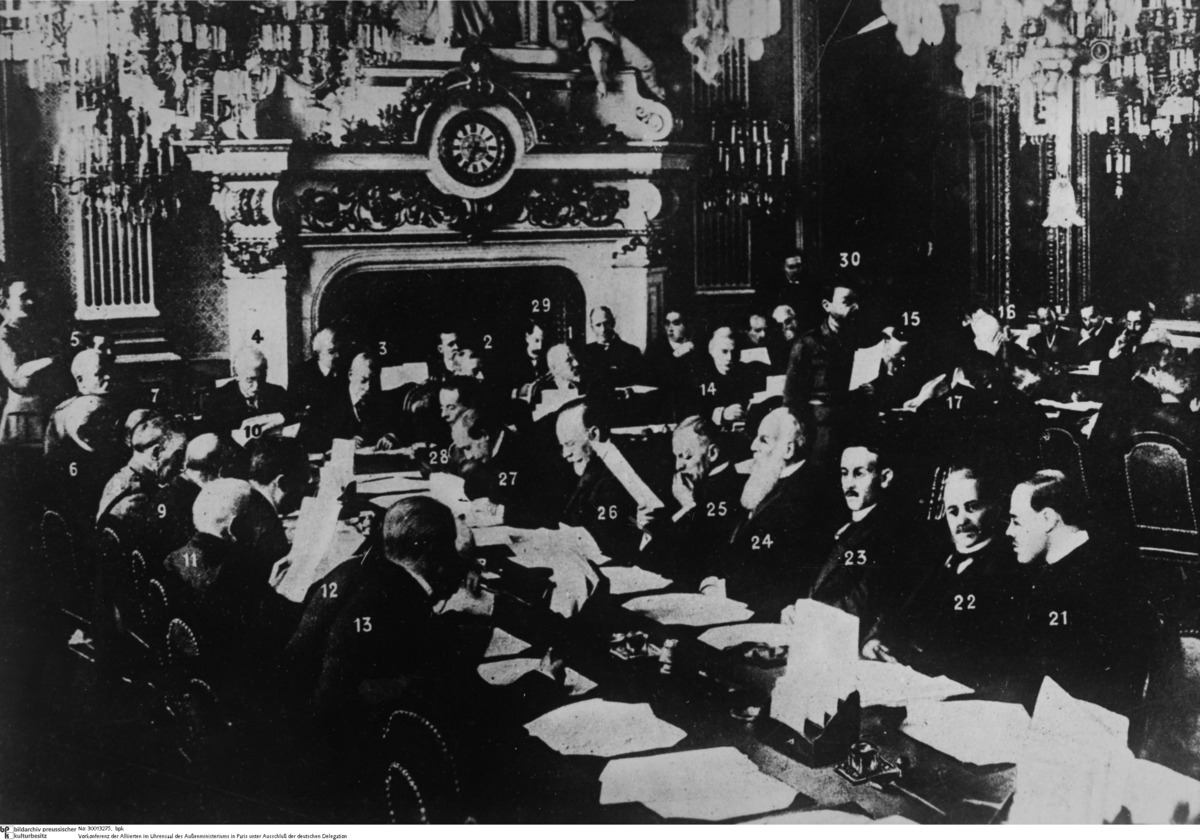
respectively. The photo shows a pre-conference between the Allies in the
Clock Hall of the French Foreign Ministry. The German delegation was
excluded from this discussion.