Abstract
After the assassination of Kurt Eisner and the subsequent outbreaks
of violence, political chaos reigned in Bavaria. Here too, a conflict
flared up between the advocates of a parliamentary republic on the one
side and those of a socialist councils’ republic on the other.
Initially, the Social Democrats around Prime Minister Johannes Hoffmann,
who carried the majority, seemed to gain the upper hand, but they too
were unable to stabilize the political and economic situation. The
radical left now saw their chances and proclaimed the “Bavarian
Councils’ Republic” on April 7, 1919. Supporters of the Prime Minister
attempted to violently suppress the supporters of the councils’ republic
on 13 April, which led to further radicalization and the loss of many
lives. A second, communist councils’ republic was proclaimed by the
workers’ and soldiers’ councils in the Hofbräuhaus. A “Red Army” was set
up, the bourgeoisie disarmed, and political opponents arrested. Civil
war-like conditions ensued in May, when the Reichswehr and Freikorps
besieged the city and, after days of bloody fighting, overthrew the
councils’ republic and took control of Munich. There were also bloody
battles in other Bavarian cities between government and Freikorps troops
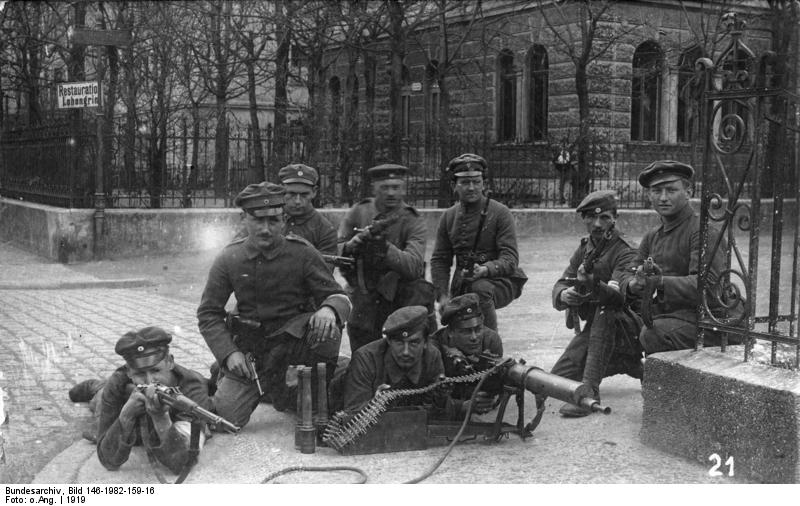
and the revolutionary republicans. This photo from April 1919 shows
soldiers with machine guns fighting in the industrial city of Augsburg.
Although the councils’ republic in Augsburg was dismissed after just
five days, after Prime Minister Hoffmann’s government threatened to cut
off the city’s food supply, bloody fighting between the Reichswehr and
workers’ and soldiers’ councils also broke out there on April 20 and
lasted for two days.