Abstract
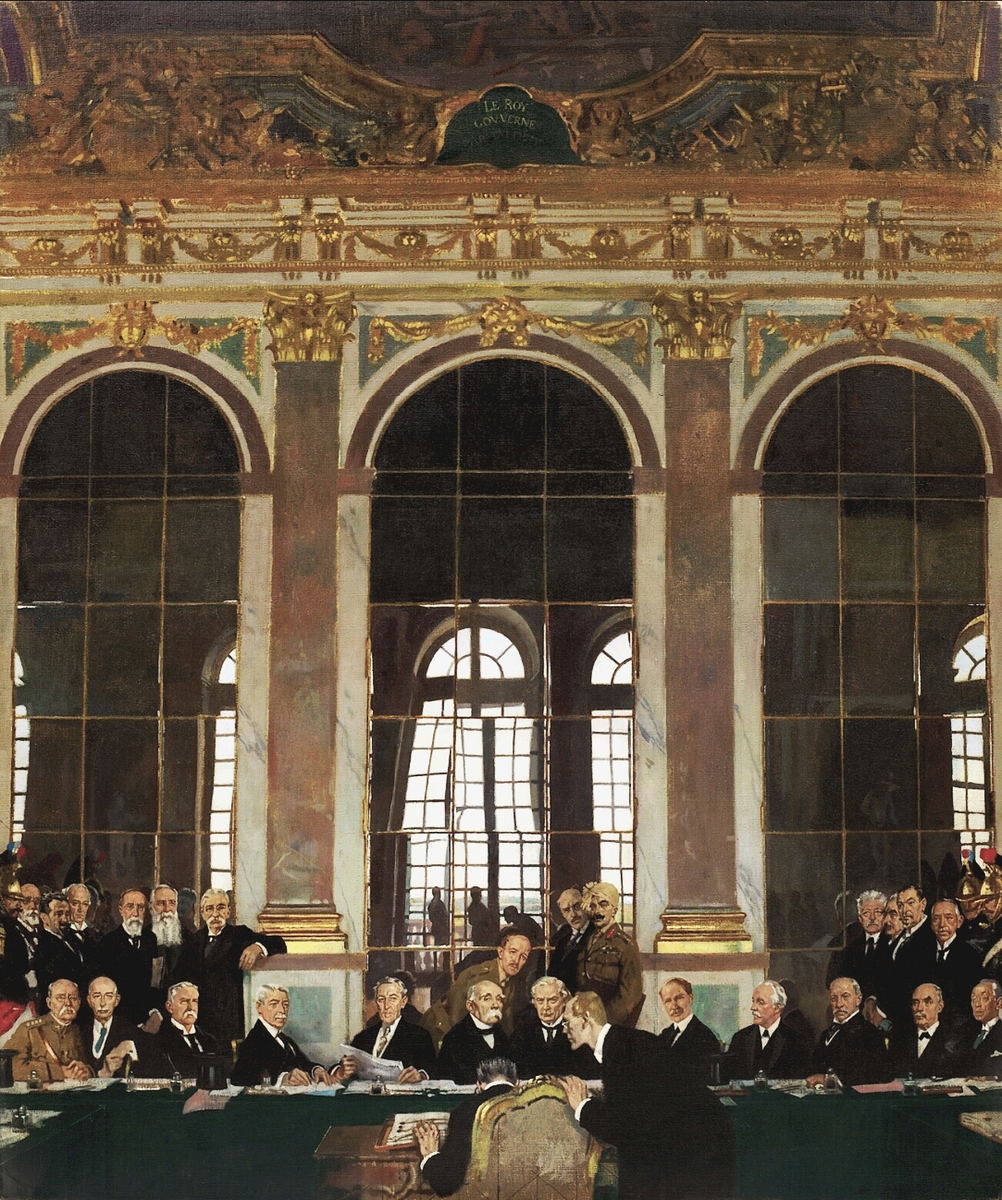
This oil painting by the Irish artist William Orpen (1878–1931)
depicts the signing of the treaty in the Versailles Palace’s Hall of
Mirrors. Orpen served as an official painter of the British army on the
Western Front from 1915 till war’s end and was then tasked with the
Paris peace talks and the signing of the resulting treaty. In the
foreground, bent over with their backs to the observer, are the two
German representatives, Minister of Transportation Johannes Bell
(seated) and Foreign Minister Hermann Müller. Shortly before, the
cabinet led by Philipp Scheidemann had resigned en masse to protest the
treaty, which they saw as a “dictated peace.” Seated at the table from
left to right are, for the United States, Army Chief of Staff Tasker H.
Bliss, “Colonel” Edward M. House (the president’s chief negotiator),
Ambassador Henry White, Secretary of State Robert Lansing, and President
Woodrow Wilson; for France, Prime Minister Georges Clemenceau; for Great
Britain, Prime Minister David Lloyd George, Chancellor of the Exchequer
Andrew Bonar Law, Secretary of State for Foreign Affairs Arthur J.
Balfour, Secretary of State for the Colonies Viscount Milner, and
Minister without Portfolio G. N. Barnes; and, finally, the head of the
Japanese delegation, Saionji Kimmochi. Standing behind them from left to
right are Eleutherios Venizelos, prime minister of Greece; Affonso
Costa, prime minister of Portugal; Lord Riddell, British press
representative; Sir George E. Foster, a delegate for Canada; Nikola Paši
(?), prime minister of Serbia; Stephen Pichon France’s foreign minster;
Sir Maurice Hankey, Britain’s secretary of the imperial war cabinet;
Britain’s secretary of state for India, Edwin S. Montagu; Major General
Sir Ganga Singh, Maharaja of Bikaner; Italy’s Prime Minister Vittorio
Emanuele Orlando; Belgium’s foreign minister, Paul Hymans; South
Africa’s prime minster, Louis Botha; and Australia’s prime minister, W.
M. Hughes.