Abstract
Labor movement leader and KPD functionary Ernst Thälmann (1886-1944),
who had grown up in Hamburg’s working-class milieu, joined the SPD in
1903 and later switched to the USPD, a splinter party. In 1920, he
joined the newly founded KPD, where he quickly rose through the ranks.
He was a member of the Reichstag from 1924 until 1933 and in 1925, he
ran as the KPD candidate for Reich President. With direct support from
Stalin, Thälmann became party chairman and carried out the party’s
“Bolshevikization,” during whose course the Social Democrats were
declared the communists’ main enemy in the late 1920s. Thälmann did not,
on the other hand, recognize the danger the rising National Socialists
posed for communists and other left-wing parties. After the National
Socialist takeover, he was arrested in March 1933. After eleven years of
incarceration, he was shot at the Buchenwald concentration camp in
August 1944. In the GDR, Thälmann was idolized as a hero of the
communist resistance.
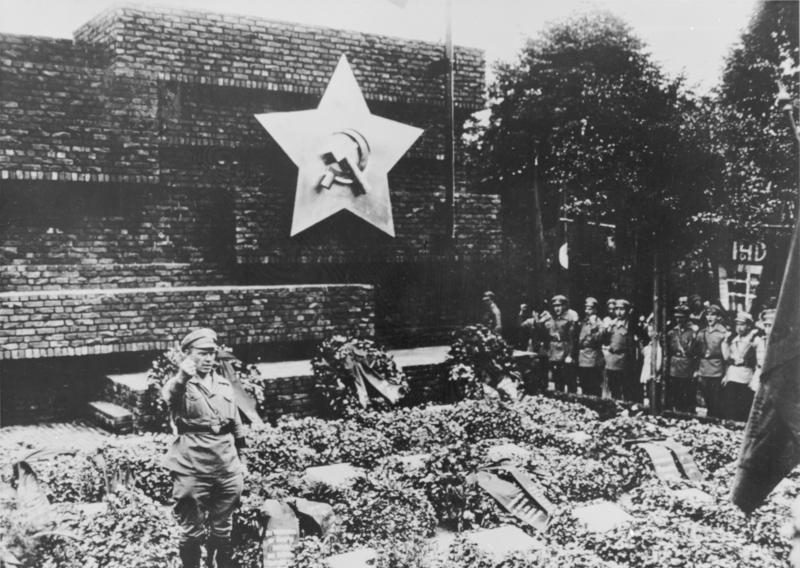
In this photograph, Thälmann stands in the foreground wearing the
uniform of the paramilitary Roter
Frontkämpferbund [Red Front Fighters’ League], for which he served
as chairman. He is shown here at the June 13, 1926, dedication of the
Memorial to the Participants in the November Revolution at the
Berlin-Friedrichsfelde cemetery. After the well-known SPD politician
Wilhelm Liebknecht was buried at this cemetery, it became the main
burial ground for Social Democrats and Socialists, including
Liebknecht’s son Karl, Rosa Luxemburg, and the left-wing victims of the
Revolution. The KPD organized annual memorial ceremonies to honor the
fallen revolutionaries, and it eventually commissioned the memorial
pictured below. It was designed by architect Ludwig Mies van der Rohe
and was composed of several staggered cuboid structures built of dark
brick. A Soviet star and a flagpole figured prominently in it. The
memorial also bore the inscription “I was. I am. I will be.”
[Ich war. Ich bin. Ich werde sein], a
quote by Ferdinand Freiligrath that aimed to establish a link to the
revolution of 1848. In 1935, the memorial was removed by the National
Socialists. The East German government had another memorial erected in
its place in 1983.