Abstract

John Hagenbeck was the half-brother of the entrepreneur Carl Hagenbeck, who, in the late nineteenth century, pioneered a number of public spectacles, performances, and exhibitions, including live displays of human beings from other parts of the world, known as Völkerschauen. These shows brought over to Germany groups of people from “exotic” locales, such as Samoa, Lappland, and the Horn of Africa; situated them in replicas of their home settlements; and highlighted for paying visitors the purported ethnological differences. John Hagenbeck capitalized on his familial connection to Carl in order to organize similar Völkerschauen of his own, as well as circuses and animal performances. John Hagenbeck even founded a film company in 1918 to film some of these spectacles and increase his audiences even more. Ludwig Ruhe, meanwhile, managed a very successful animal dealership that supplied a number of German zoos as well as Völkerschauen.

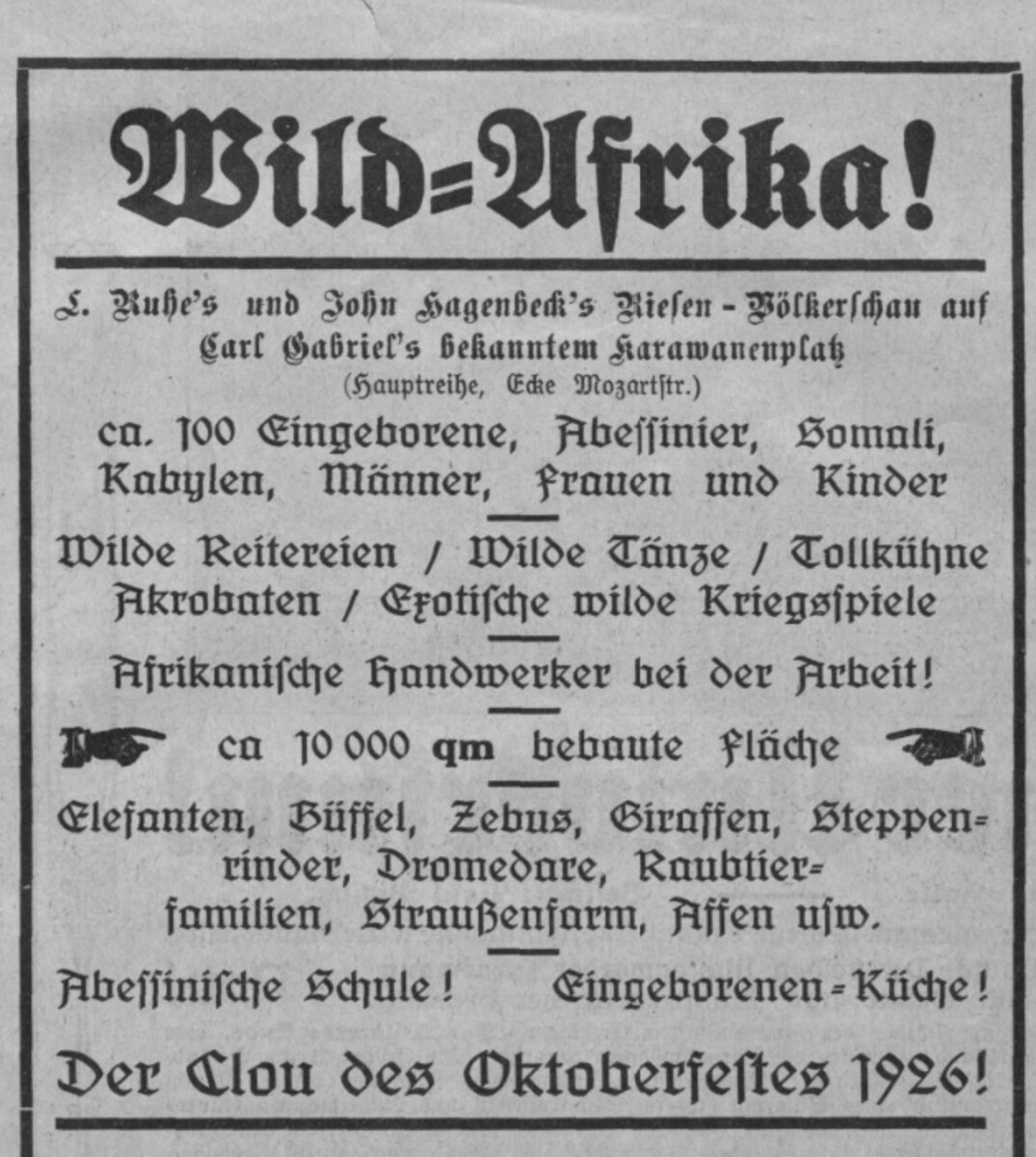
This advertisement for a “Wild Africa” exhibition at the 1926 Munich Oktoberfest drew on the public’s fascination with the people as well as the animals of Africa. It used the adjective “wild” on four occasions, highlighting the ethnological difference on display and even suggesting a hint of eroticism in connection with “wild dances.” During this period, exoticized black bodies were on display in contexts other than the Völkerschauen as well, for example in musical performances.

Advertisement for a Völkerschau in Munich (1926)

Source

Wild Africa!

L. Ruhe’s and John Hagenbeck’s Major People Exhibit at
Carl Gabriel’s well-known caravan park
(Hauptreihe, at the corner of Mozartstr.)

c. 100 native people, Abyssinians, Somalis,
Kabyles, men, women, and children

Wild riding / wild dances / intrepid
acrobats / exotic wild war games

African craftspeople at work!
c. 10,000 sq m of built structures
Elephants, buffalos, zebus, giraffes, cattle from the steppes,
dromedaries, beasts of prey,
ostrich farm, apes, etc.

Abyssinian school! Native cooking!

The chief attraction of Octoberfest 1926!
Source: Offizielle Münchner Oktoberfest-Zeitung (1926), p. 13. Available online: https://www.bavarikon.de/object/bav:BSB-MDZ-00000BSB00048960?lang=de

Münchener Digitalisierungszentrum