Source
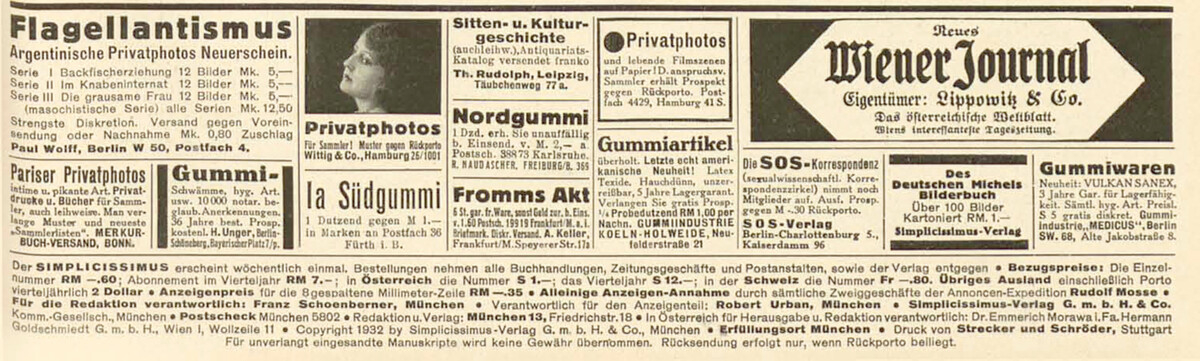
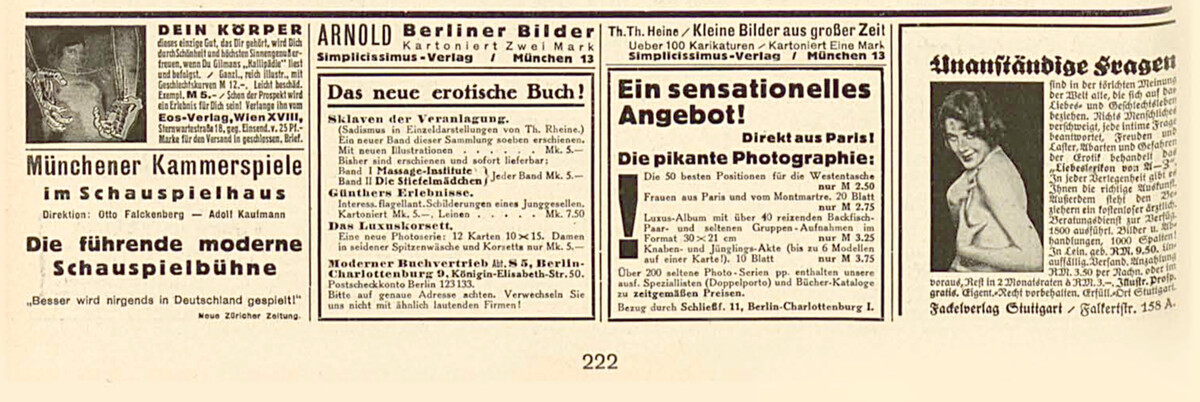
Source: Simplicissimus, Jg. 37, Nr. 19, August 7, 1932, pp. 222-23. Available online: http://www.simplicissimus.info/uploads/tx_lombkswjournaldb/pdf/1/37/37_19.pdf
Weimar Germany has a reputation to this day for remarkable sexual permissiveness, and although this reputation has fostered both myth and exaggeration, it did stem from a genuine openness to discussing sexual issues—including pioneering movements for gay rights and reproductive rights—and a relatively light touch when it came to the regulation of behaviors, products, and services.
These classified ads, taken from a 1932 issue of the satirical magazine Simplicissimus, show the extent to which businesses and individual purveyors could openly advertise and sell birth control and erotica in Germany at the time. These products were offered through mail order, but erotic publications were generally available in stores and newsstands in most large cities, and one could usually buy condoms and sometimes other birth-control and sexual aids in pharmacies.
The Weimar Republic appeared open and tolerant primarily in comparison to other countries at this time, however, and it still censored certain things and policed certain behaviors. Some of the products advertised here could only describe themselves in euphemistic terms. “Sittengeschichte,” for instance, could refer to the history of customs and practices within a given culture, but it was generally understood to refer primarily to the history sexuality and erotica, going light on the history part. The store advertising its catalog of books on “Customs and Cultural History,” therefore, could communicate with a wink to buyers what it was actually selling, while employing a term that still offered a veneer of “respectability.” The term “private photographs” [Privatphotos] functioned in the same way, as could the term “sexual science” [Sexualwissenschaft], although this term referred at least as often to the emerging field of academic study at the intersection of medicine, anthropology, sociology, and psychology that German intellectuals such as Magnus Hirschfeld had pioneered.
Several advertisements promoted “Gummiwaren,” “Gummiartikel,” or “Fromms Akt,” all of which referred to condoms. The ads for “Fromms Akt” likely peddled knockoff versions of the widely used and respected “Fromms Act” condoms, developed by Julius Fromm in 1912 and sold by 1919 in packages of six as the world’s first brand-name prophylactic. The Fromms company supplied much of Germany’s domestic demand and exported widely, as well.
A year after the Nazis came to power, Heinrich Himmler issued a police decree banning the advertisement of condoms, because it conflicted with the Nazis’ policy of encouraging large families. In 1938, Julius Fromm’s company was forcibly “Aryanized,” and Fromm, a German Jew, emigrated to Britain.
Source: Simplicissimus, Jg. 37, Nr. 19, August 7, 1932, pp. 222-23. Available online: http://www.simplicissimus.info/uploads/tx_lombkswjournaldb/pdf/1/37/37_19.pdf