Abstract
The jurist und politician Karl Liebknecht (1871–1919), son of the
Social Democrat Wilhelm Liebknecht, joined the SPD in 1900 and was on
the Berlin city council until 1913. His open criticism of militarism and
war repeatedly earned him prison sentences. He entered the Reichstag in
1912, where he represented the extreme left wing of the SPD. In 1916, he
and Rosa Luxemburg published the radical
Spartacus Letters, which led to his
exclusion from the SPD Reichstag fraction. After organizing a peace
demonstration in Berlin in 1916, he was sentenced to prison for high
treason and lost his Reichstag mandate. A general amnesty was declared
in October 1918, leading to Liebknecht's early release. He and Rosa
Luxemburg then founded the socialist Spartakus League, distancing
themselves from both the SPD and USPD and later becoming founding
members of the KPD. On November 9, 1918, he attempted to establish
socialism as Germany's new state form by proclaiming a “free socialist
republic” two hours after Philipp Scheidemann had proclaimed the “German
republic.” Following the Spartacist uprising in January 1919, Liebknecht
and Luxemburg were arrested by free corps soldiers, who interrogated,
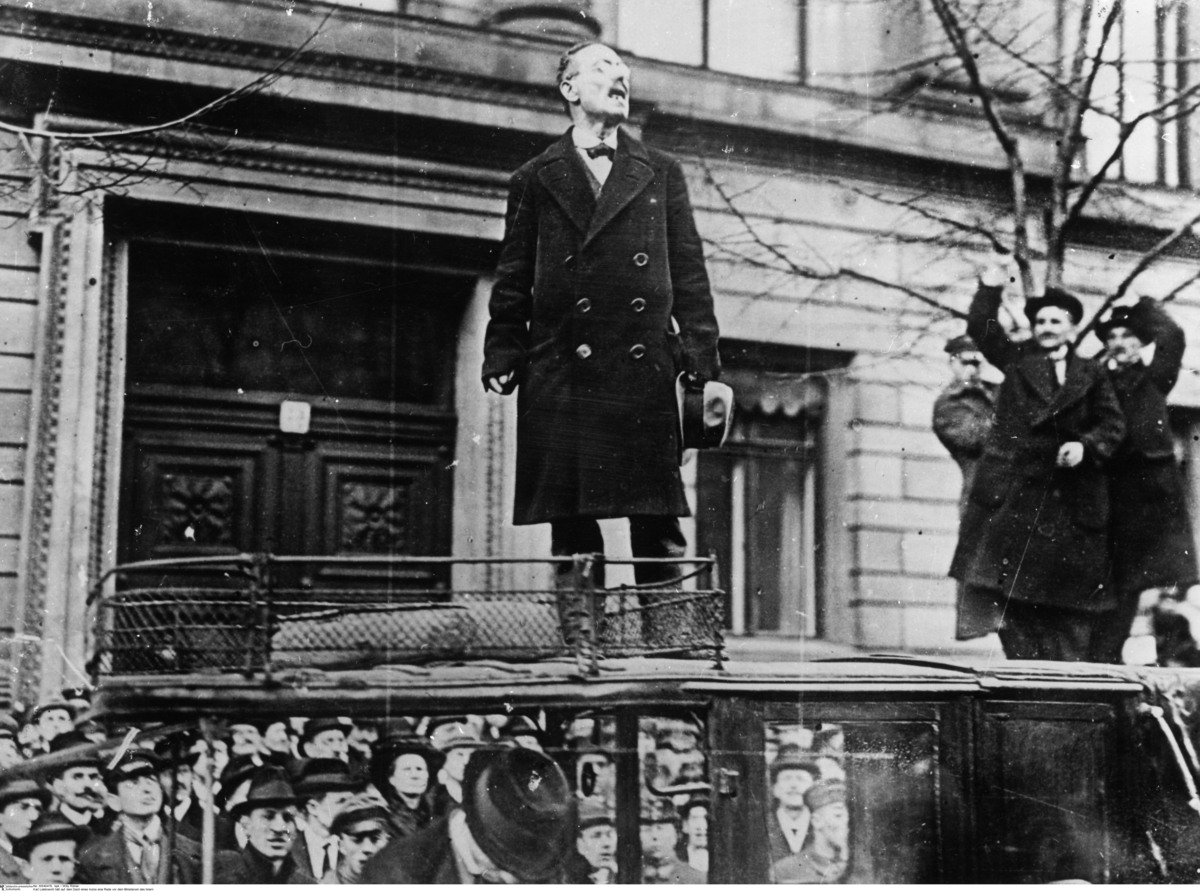
mistreated, and shot them. This photograph shows Liebknecht at a rally
in front of the Ministry of the Interior in January 1919.