Abstract
On January 25, 1919, thirty-one revolutionaries killed during the
January uprising were buried in a mass grave in the
Berlin-Friedrichsfelde cemetery. Among the dead was Karl Liebknecht, who
like Rosa Luxemburg had been arrested and shot by the free corps.
Because Luxemburg’s body wasn’t found until months later, only an empty
coffin could be buried for her on this day. Press reports initially
adopted the official explanation of the military, which claimed that
Liebknecht had been shot trying to escape and that Luxemburg had been
killed by an angry mob. Later, the officers involved in the murders were
placed before a court martial, but they were either acquitted or did not
have to serve their prison sentence. The exact circumstances of these
deaths were only researched decades later. Meanwhile, increasingly vocal
criticism of the SPD transitional government could be heard not just
among workers and soldiers but also in the bourgeoisie, who blamed the
government for the violence and for the murderers going unpunished. As
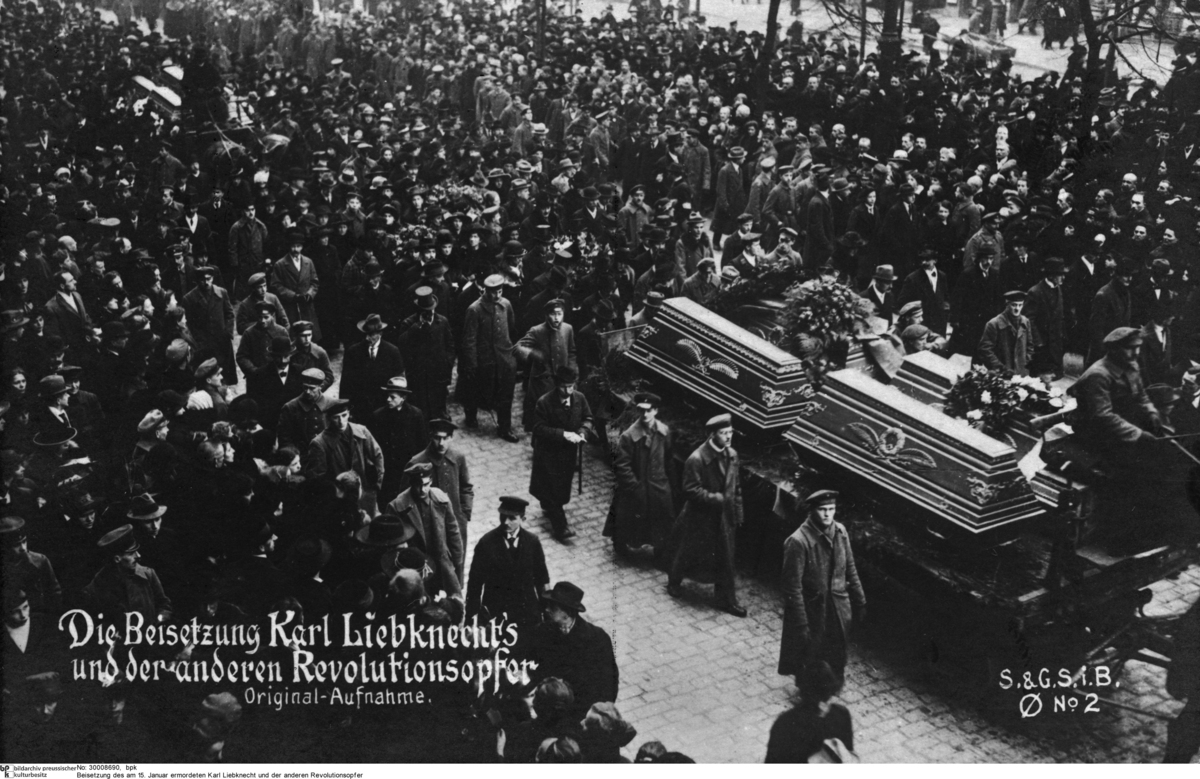
this photograph shows, a huge crowd took part in the funeral procession,
which became a mass demonstration of KPD and USPD supporters. In order
to prevent an escalation of the demonstration, government and free corps
troops conducted many “security checks” in the city.