Source
1. Meyer-Stube (Xantener Strasse 3, just south of Ku’damm, near
Adenauerplatz), 1927-28 2. Eldorado, a later club that coopted the name (Kantstrasse 24), 1926 3. The Prinzeß-Theater, where the pioneering gay film Anders als die Andern,
likely the first feature-length film anywhere to focus on homosexuality,
premiered on May 31, 1919. It thereafter screened at the theater three times
daily (Kantstrasse 163, in the Charlottenburg neighborhood). With the
reintroduction of film censorship in May 1920, the state banned the
film. 4. Monokel-Diele, run by the legendary club organizer Lotte Hahm (Budapester
Strasse 14, Schöneberg), 1932–33 5. Auluka-Lounge (Augsburger Strasse 72, near Wittenbergplatz), 1924-33 6. Silhouette, a favorite of Ernst Röhm, the Nazi SA leader (Geisbergstrasse
24 Schöneberg, just NW of Viktoria-Luise-Platz), 1926-33 7. Mali and Igel (Lutherstrasse 16, near Bavarian Quarter), 1927-33 8. Eldorado, a third club that coopted the name (Martin-Lutherstrasse 29),
ca. 1927-32 9. Eldorado, the fourth and most famous club under this name (on the corner
of Motzstraße and Kalckreuthstrasse), 1928-32 10. Verona-Lounge (Kleiststrasse 36, between Wittenbergplatz and
Nollendorfplatz), 11. 11. Toppkeller, frequented by the cabaret singer Claire Waldoff
(Schwerinstrasse 13, just SE of Nollendorfplatz), 1923-32 12. Café Olala (Zietenstrasse 11, just east of Nollendorfplatz), 1927-32 13. Hohenzoffern-Café (Bülowstrasse 101, just east of Nollendorfplatz),
1921-1933 14. Café Dorian Gray (Bülowstrasse 57), 1921-33 15. The Institut für Sexualwissenschaft, founded by the sexologist and
pioneering gay-rights activist Magnus Hirschfeld, offered medical services,
spaces for meetings and lectures, a permanent museum exhibition on sexual
history, and a gathering place for queer emancipation (In den Zelten 10,
Beethovenstrasse 3, in the Tiergarten, roughly where the Haus der Kulturen
der Welt is currently located), 1919-1933. 16. Die Kaisergalerie, also known as Die Passage, was a shopping arcade and
well-known cruising area for gay men (between Unter den Linden and
Friedrichstrasse), since the late nineteenth century. 17. Bürger-Casino (Friedrichsgracht 1, on the Fischerinsel), 1927-32 18. Café Kobold (Holzmarktstrasse 3, Friedrichshain, just east of the
Jannowitzbrücke), c. 1924-25 19. Alexander-Palast (Landsberger Strasse 39, due east of Alexanderplatz
station, near Georgen-Kirche) 20. Taverne (Georgenkirchstrasse 30a, just east of Friedrichstrasse), 1925-32 21. Mikado Bar (Puttkamerstrasse 15), 1907-1933 22. Die Spinne, also known as “Kabarett Die Spinne” and Spinndiele (Alte
Jakobstrasse 174, Kreuzberg), 1920-21 23. Adonis-Diele (Alexandrinenstrasse 121, just west of Moritzplatz in
Kreuzberg), 1920-1924; which then reopened across the street
(Alexandrinenstrasse 1a), 1926-33 24. Zauberflöte (Kommandantenstrasse 72, just south of U Spittelmarkt),
1926-33 25. Eldorado, four different clubs adopted this name in succession, but the
original was in Kreuzberg (Alte Jakobstrasse 60), 1919-21 26. A queer bookstore, as well as the administrative address of the
nationwide gay-rights organization run by Friedrich Radszuweit, the Bund für
Menschenrecht, operated at Neue Jakobstrasse 9 (in Mitte, near the
Märkisches Museum), 1927-33 27. Cosy Corner, also known as Noster (Zossener Strasse 7, Kreuzberg to the
south of the Landwehrkanal), 1909-33 (one of Christopher Isherwood’s
favorite haunts) 28. Domino-Diele (Baerwaldstrasse 61, Kreuzberg), 1920-21 29. Bundesheim, previously known as Zum Patzenhofer, and then later as
Heideblume and, after 1929, as Monte-Casino (Planufer 5, on the
Landwehrkanal, west of Kottbusserstrasse), 1919-33 30. The “Soldatenstrich” (the cruising area for men looking to have sex with
soldiers) was located near the Tempelhoferfeld, where lots of barracks were
situated and had existed as a cruising area since the
nineteenth century.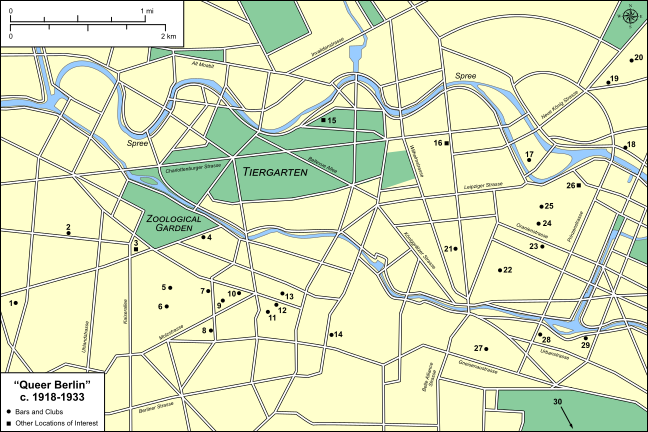
1919-31
Source: Nathalie Boegel, “Ich bin Babel, die Sünderin" and “Berlin: Hauptstadt des Verbrechens,“ in: Spiegel Geschichte, September 17, 2018; Jens Dobler, Von anderen Ufern: Geschichte der Berliner Lesben und Schwulen in Kreuzberg und Friedrichshain (Berlin: Bruno Gmünder Verlag, 2003); Mel Gordon, Voluptuous Panic: The Erotic World of Weimar Berlin (Los Angeles: Feral House, 2006), pp. 218-19. Cartography by Gabriel Moss in collaboration with Erik Jensen, 2022.