Source
Places marked on the map: Weimar: Walter Gropius founded the
Bauhaus school in Weimar in 1919, and the school remained there until
1925. Dessau: The Bauhaus moved here in
1925, where its reputation as an international design school solidified.
The Nazi-controlled city government voted to close it in 1932. Berlin: The Bauhaus moved here in
1932 and was forced to close by the Nazis in 1933. Modern architects and
city planners, including Hans Scharoun, Walter Gropius, Bruno Taut, and
Martin Wagner designed residential communities in the late 1920s,
including Siemensstadt, the Hufeisensiedlung, and the
Onkel-Tom-Siedlung. Bernau bei Berlin: Bauhaus director
Hannes Meyer designed the landmark ADGB Trade Union School here,
1928-1930. Erfurt: Bauhaus student Margaretha
Reichhardt opened a hand-weaving school and workshop in 1933. Frankfurt: The “New Frankfurt”
program, led by chief architect Ernst May, constructed 12,000 modern
dwellings between 1925 and 1931, most of which featured the
efficiency-minded “Frankfurt Kitchen,” designed by Margarete
Schütte-Lihotzky. Essen: Shaft 12 of the Zollverein
Coal Mine, 1928-32, is considered a landmark of modern industrial
design. Stuttgart: The Weissenhofsiedlung
was unveiled in 1927 to showcase modern international architecture and
design. Brno: Third and final Bauhaus
director Mies van der Rohe designed the Villa Tugendhat here in
1929. Moscow: Former Bauhaus director
Hannes Meyer worked on large-scale housing projects in the early
1930s. London: The Isokon Flats, a modern
experiment in minimalist and semi-communal living, opened in 1934, and
early residents included Bauhaus émigrés. New York: The Museum of Modern Art
(MoMA) opened the exhibition “Bauhaus: 1919-1928” in 1938 in recognition
of the school’s global influence on art and design. Chicago: László Moholy-Nagy founded
a “new Bauhaus,” the Institute of Design at the Illinois Institute of
Technology, in 1937. Architect and former Bauhaus director in Berlin
Mies van der Rohe joined soon thereafter. Asheville, NC: Bauhaus alumni Josef
and Anni Albers shaped the arts program and overall vision of Black
Mountain College from 1933 to 1949. Cambridge, MA: Walter Gropius taught
at—and served as the guiding light for—the Harvard Graduate School of
Design from 1937 to 1952, where Marcel Breuer joined him for a for a
four-year period. Tel Aviv: A number of Central
European Jewish architects, many having trained at the Bauhaus, designed
thousands of buildings in the “White City,” a modern, planned community
developed in the 1930s.) Ankara: Modern architects Ernst
Egli, Margarete Schütte-Lihotzky, and Bruno Taut, as well the city
planner Martin Wagner, contributed to the design of the new Turkish
capital in the 1920s and 1930s. West Bengal: Bauhaus ideas
influenced new design elements at the Visva-Bharati University, whose
leader Rabindranath Tagore organized a 1922 exhibition featuring artists
from the Bauhaus and India’s own avant-garde scene.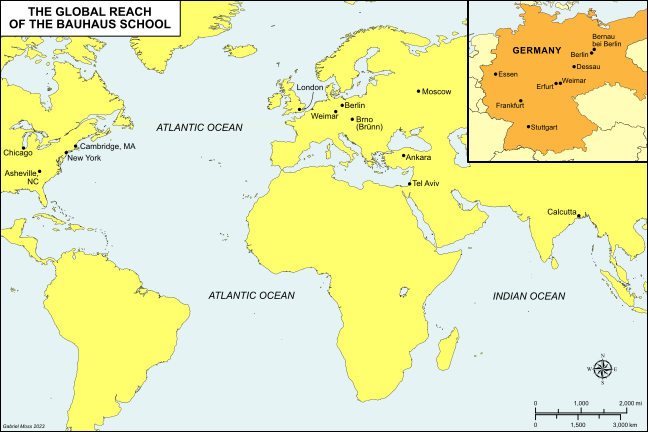
Source: Cartography by Gabriel Moss in collaboration with Erik Jensen, 2022.