Source
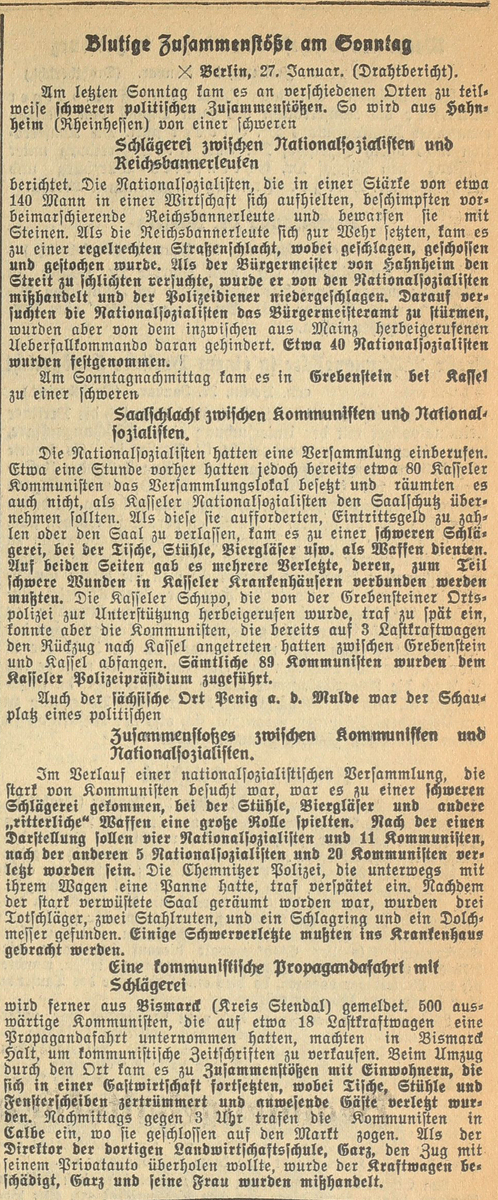
Source: Riedlinger Zeitung, January 27, 1931, via Deutsches Zeitungsportal.
The early years of the Weimar Republic were already shaken by political murders of democratic politicians, most of which were carried out by radical right-wing opponents of the Republic. In the final years of the Weimar Republic, between the stock market crash of 1929 and the National Socialists' seizure of power on 30 January 1933, political violence among supporters of the NSDAP, the Communist Party and the Social Democratic Party, organized in paramilitary associations, increased dramatically. Violence broke out at various large public rallies and street protests, for example during the “Bloody Sunday” in Hamburg-Altona in July 1932. However, most of the political violence during this phase did not occur at public rallies or protests on the street, but at smaller gatherings, usually in closed rooms, often in beer halls or other meeting places in smaller towns or rural areas. Communists and Social Democrats frequently disrupted meetings of the NSDAP, which led to clashes in which members of the SA on the one side and the Communist “Red Front Fighters' League” and the Social Democratic “Reichsbanner Schwarz-Rot-Gold” on the other attacked each other with chairs, tables, drinking glasses and other weapons they had to hand.
This newspaper clipping from the Riedlinger Zeitung of January 27, 1931 contains several reports of violent clashes on a single Sunday at gatherings in towns all over Germany, from Berlin to the small town of Grebenstein.
Source: Riedlinger Zeitung, January 27, 1931, via Deutsches Zeitungsportal.