Abstract
In January 1919, the revolution took a decisive and violent turn,
shaking the foundations of the emerging republic. After the Christmas
rebellion in Berlin and the collapse of the SPD–USPD governing
coalition, the atmosphere in the capital was inflamed. When the Berlin
police president, Emil Eichhorn (USPD), was fired on January 5 for
ostensibly supporting the People’s Marine Division, the Spartacus League
took the opportunity to incite revolutionary workers and soldiers to
rebellion and to declare the dismissal of the Council of People’s
Deputies. Left-wing extremist revolutionaries occupied Berlin publishing
houses, and a revolutionary committee was formed, albeit one that proved
incapable of acting. After negotiations with the Council of People’s
Deputies collapsed, Gustav Noske ordered the Reichswehr to put down the
rebellion. Ruthless, civil war–like street fighting ensued, permitting
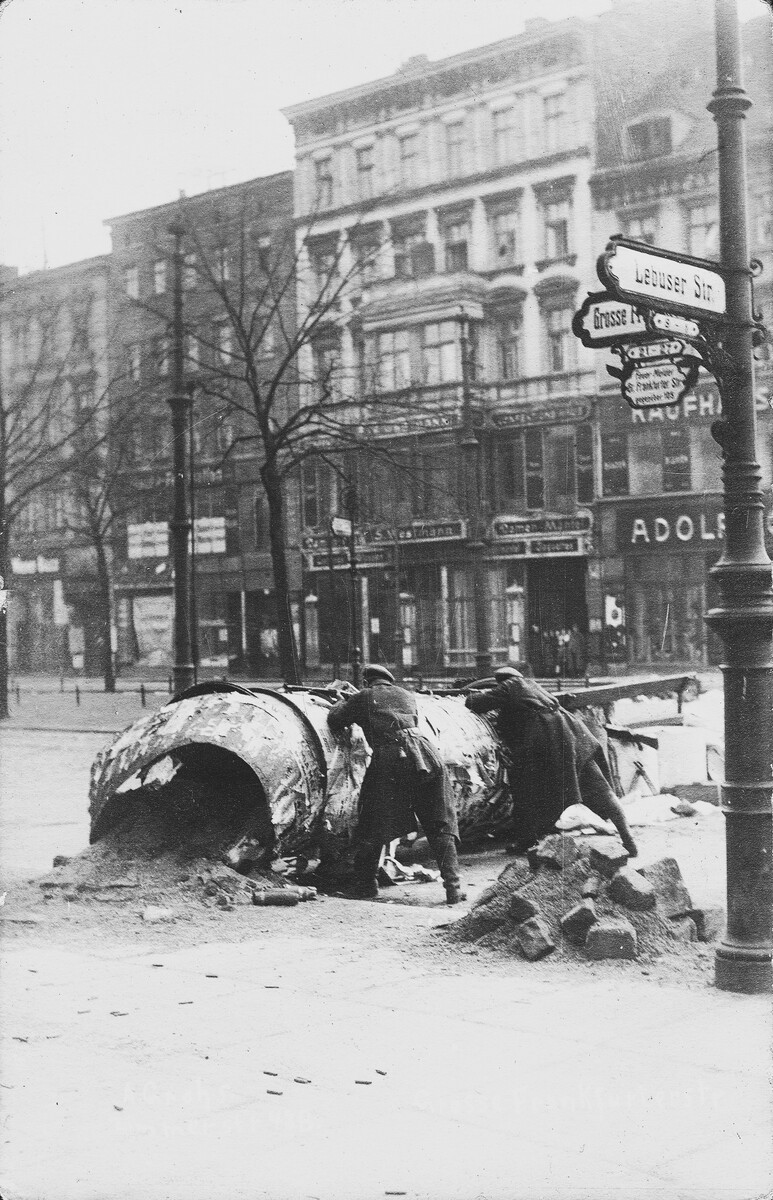
the Reichswehr to strengthen its own position. This photograph by Alfred
Grohs, a possible reenactment, shows a scene from the street fighting at
the corner of Grosse Frankfurter Strasse today Karl-Marx-Allee) and
Lebuser Strasse in Berlin-Friedrichshain. The violence did not end with
the defeat of the rebellion. In a political clean-up operation, the army
and free corps combed through Berlin’s working-class area to find and
eliminate revolutionary workers. This operation also took the lives of
the Spartacist leaders Rosa Luxemburg and Karl Liebknecht.