Source
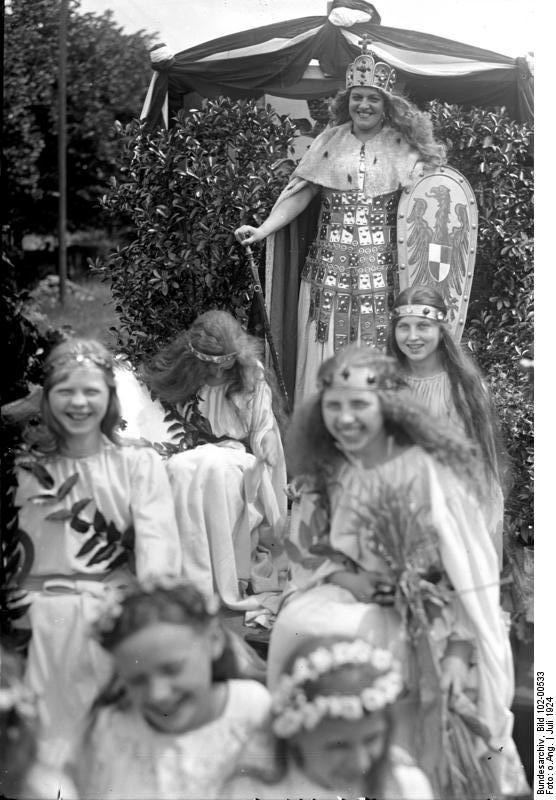
The tradition of shooting clubs in Germany dates back to the Middle Ages, when townspeople joined forces to protect themselves against the nobility. During the Weimar Republic, shooting clubs and their annual marksmen’s festivals [Schützenfest] remained an integral part of local tradition, especially in rural areas. In July 1924, the shooting club in the village of Treuenbrietzen in Brandenburg, located southwest of Berlin, with a population in the 1920s of roughly 5,700 people, celebrated its 500th anniversary. The celebrations were held in typical folk-festival fashion, including a pageant that showcased local traditions and, as seen in this photo, a young woman dressed as Germania on a decorated float. Also visible in the picture are several young girls dressed as “noblewomen” in white, accompanying Germania. Depictions of Germania, the personification of the German nation, became particularly popular in the nineteenth century. As this example shows, however, they were not limited to monuments and paintings, but, as the embodiment of German history and nation, could also be part of folk celebrations.
wikimedia commons
