Source
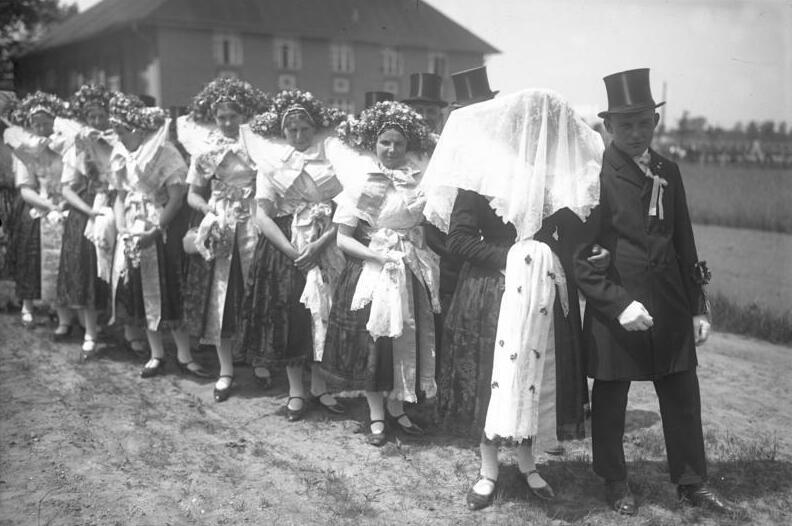
Source: A Wendish wedding in the Spreewald, April 1931. Photo: Georg Pahl. Bundesarchiv Bild 102-11632. wikimedia commons: https://commons.wikimedia.org/wiki/File:Bundesarchiv_Bild_102-11632,_Spreewald,_Wenden-Hochzeit.jpg
“Wends” was a term used to describe the Slavic minorities who lived in German-speaking areas (in some areas they are also referred to as Sorbs). Wendish communities existed mainly along and east of the Elbe River, as well as in the Upper Palatinate, Upper Franconia and the Eastern Alps. This photograph from April 1931 documents a Wendish wedding in the Spreewald, a swampy, heavily forested, and thinly populated region in Brandenburg, south of Berlin. Both the bride and groom, as well as the members of the wedding procession, are wearing traditional Wendish costumes, which are still common on special occasions today. The elaborate costumes of the women, which consist of embroidered bonnets and dresses, identify them as members of a particular community. While the Weimar era was shaped by political upheaval and social changes unfolding particularly in its urban centers, in many rural areas, traditions such as wearing local costumes, celebrating folk festivals, and established social hierarchies continued to be observed. At the same time, cultural preservation in the Spreewald and other rural areas was beginning to serve the economic interest of a budding German tourism industry.
Source: A Wendish wedding in the Spreewald, April 1931. Photo: Georg Pahl. Bundesarchiv Bild 102-11632. wikimedia commons: https://commons.wikimedia.org/wiki/File:Bundesarchiv_Bild_102-11632,_Spreewald,_Wenden-Hochzeit.jpg
wikimedia commons
