Source
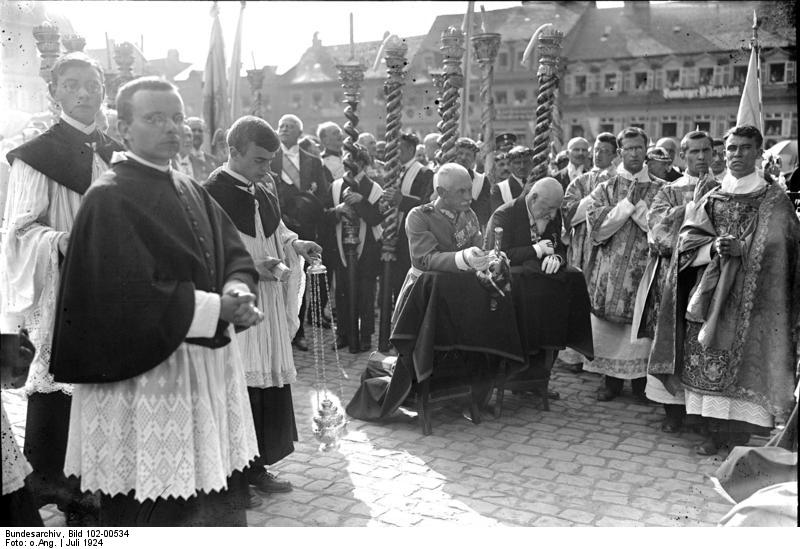
A large Catholic procession took place to celebrate the 900th anniversary of the town of Bamberg, in Upper Franconia in the northern part of Bavaria, in July 1924. In attendance were the papal nuncio Eugenio Pacelli (the future Pope Pius XII), all the archbishops of Germany and numerous other church dignitaries, as well as the former Crown Prince Rupprecht of Bavaria and the former Tsar Ferdinand of Bulgaria. Pacelli had been nuncio—the Vatican’s ambassador to Germany—since 1920. In March 1924, he had negotiated a concordat (a state-church treaty) between the Vatican and the Free State of Bavaria, which regulated the relationship between the state and the Catholic Church after the end of the monarchy. The concordat granted the Catholic Church extensive rights with regard to school and university education and secured its funding through a church tax. In this photo by the press photographer Georg Pahl, Rupprecht of Bavaria (kneeling left) and Ferdinand of Bulgaria (kneeling right) attend the public prayer service in Bamberg. Rupprecht of Bavaria, a member of the Wittelsbach dynasty whose kings had also been the sovereigns of the Catholic Church in Bavaria before the November 1918 Revolution, rejected the republic and hoped for the restoration of the monarchy in Bavaria. Ferdinand of Bulgaria, meanwhile, had abdicated after Bulgaria’s defeat in 1918—Bulgaria had been a member of the Central Powers, in alliance with Germany and Austria-Hungary— and subsequently lived in exile in Coburg, just 30 miles north of Bamberg. Public events like this one demonstrated how strong the influence of the Church and the respect for abdicated monarchs remained in many parts of Germany throughout the Weimar Republic.
wikimedia commons
