Abstract
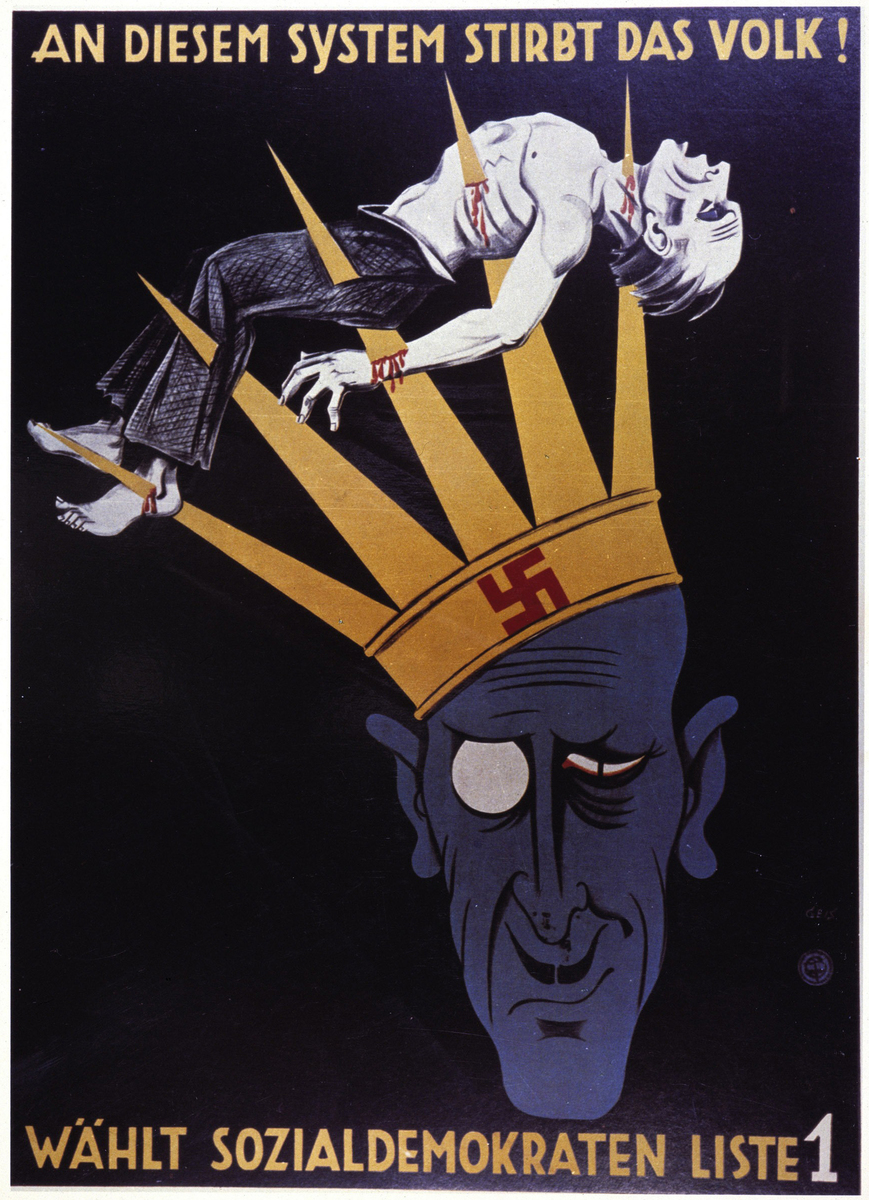
Shortly after the presidential election of March/April 1932, in which
Hindenburg was reelected, voters were called upon to vote in a Reichstag
election on July 31, 1932. This SPD election poster warns of the threat
posed by National Socialists (symbolized by the swastika crown), on the
one hand, and the noble, military, industrial, and national conservative
elites (symbolized by the monocle), on the other. It was feared that the
election of either would endanger the well-being of the people. During
an election campaign marked by riots and extremist violence, several
cities saw street fighting and battles in meeting halls between the SA,
the Communist Rotfrontkämpferbund, and the Reichsbanner
Schwarz-Rot-Gold, in which numerous people were killed. The government
reacted by declaring a state of emergency in the capital of Berlin,
where riots were considered particularly dangerous. This enabled the
ouster of the Social Democrat-led Prussian government as part of the
so-called Preußenschlag [Prussian campaign]. On election day, voter
turnout was remarkably high at 84.1%. The SPD lost about 3% of votes
compared to the 1930 election and became the second strongest party in
the Reichstag after the NSDAP. The third place finisher was the KPD,
which, like the NSDAP, gained votes. The drastic loss of support for the
democratic center parties proved to be particularly fateful for the
Republic. Since no government could be formed due to the distribution of
mandates, new elections were held in November of the same year. This did
not change the distribution of power much, however. The November 1932
election turned out to be the last free election of the Weimar
period.