Abstract
The national assembly was elected on January 19, 1919, and on
February 6 it held its constitutive meeting in the National Theater in
Weimar. The body met away from the capital because revolutionary unrest
had made it appear too insecure. The national assembly met in this
theater from February 6 to August 11. Its main tasks were to establish
the separation of powers, to form a government, and to draw up a
constitution. Friedrich Ebert, who had chaired the Council of People’s
Deputies, was elected president of Germany and Philipp Scheidemann, also
a former people’s deputy, was tasked with forming a government. On
February 13, the so-called Weimar Coalition (SPD, DDP, and the Center
Party) was founded. Soon it was put to the test, when the national
assembly, under pressure by the Entente powers, signed the Versailles
treaty on June 23 despite strong opposition inside the Scheidemann
cabinet. Debates over the republic's future constitution were also
passionate. The Weimar constitution, drafted by Hugo Preuss, was finally
passed on July 31, and President Ebert signed it on August 11. This
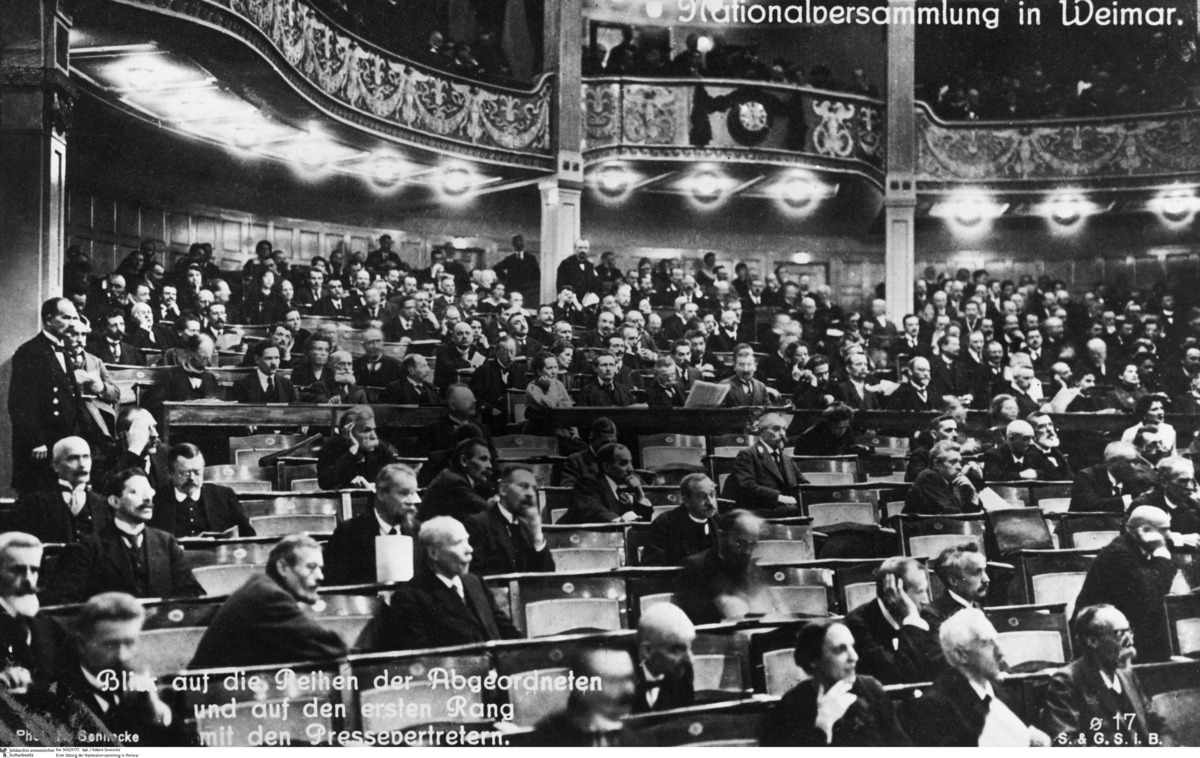
February 6 photograph offers a view inside the theater, in which the
representatives met. Among them one can see several of the 37 female
representatives to the body.