Source
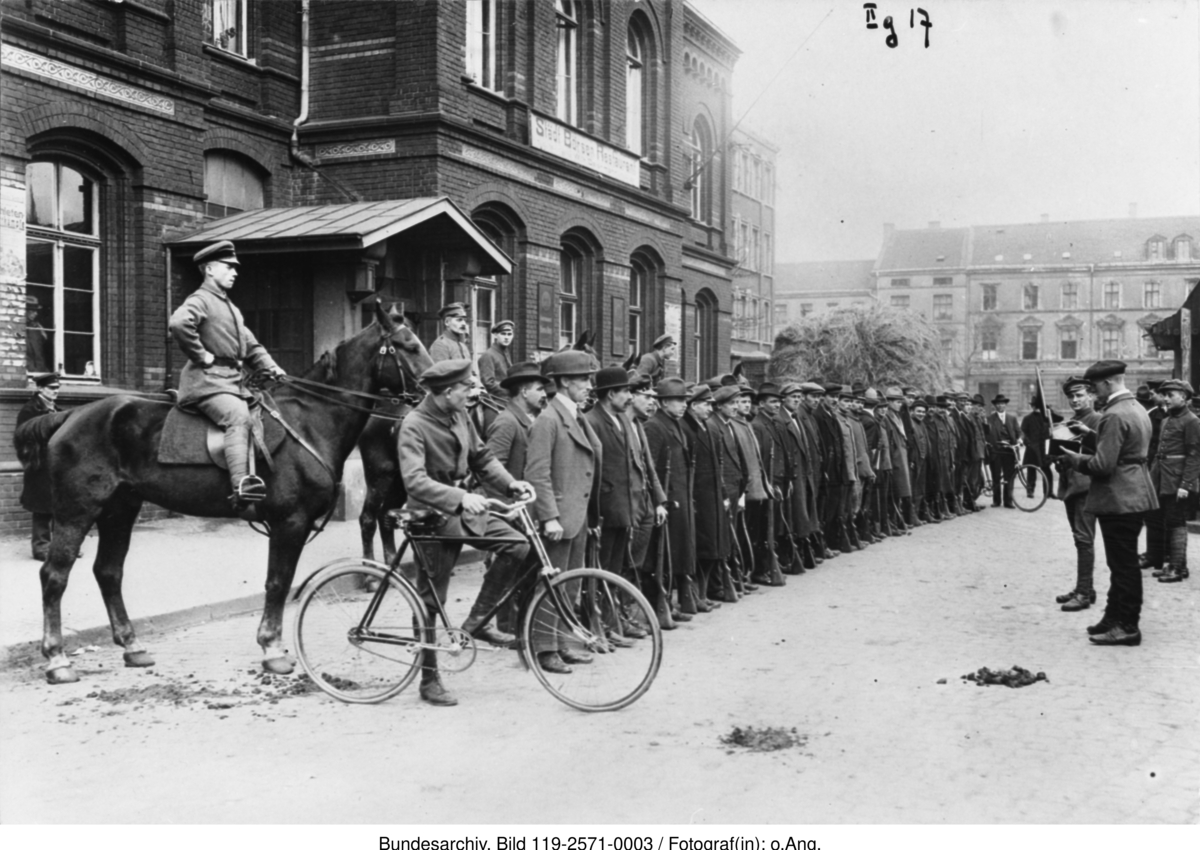
Source: Die Rote Ruhrarmee beim Gewehrappell, 1920. Unknown photographer. Bundesarchiv Bild 119-2571-0003.
Triggered by the workers’ general strike that derailed the Kapp-Lüttwitz putsch, numerous strikes and revolutionary uprisings broke out among workers in March 1920, which were directed against the republic and its government. In the Ruhr region in particular, there were fierce battles between armed workers, who hoped to revive the revolution of 1918/19 and finally achieve socialist goals such as the socialization of the economy, and army units and the security police. This “Red Ruhr Army,” which had around 50,000 armed members and consisted largely of war veterans turned supporters of the KPD and USPD without a common political program, had gained control of the industrial area of the Ruhr after violent battles. The government under Chancellor Hermann Müller (SPD) feared not only for the political stability of the fledgling republic, but also for control over coal production. After attempts at negotiation had failed, government troops marched into the Ruhr region on April 3, 1920 and, with the support of the Freikorps, many of whom had only recently supported the Kapp-Lüttwitz putsch against the government, brutally crushed the uprising. It is estimated that around 1,000 insurgents and 200 Reichswehr soldiers died during the fighting, and numerous other insurgents were shot after being arrested. This photo shows armed members of the “Red Ruhr Army” during a roll call on a street in Dortmund.
Source: Die Rote Ruhrarmee beim Gewehrappell, 1920. Unknown photographer. Bundesarchiv Bild 119-2571-0003.
Bundesarchiv