Abstract
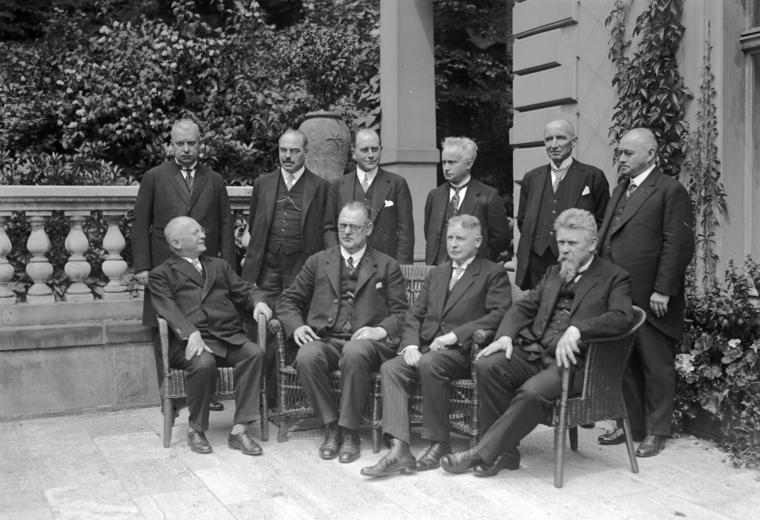
The second cabinet led by Social Democratic Chancellor Hermann Müller
(1876-1931) consisted of a Grand Coalition formed by the SPD, DDP,
Zentrum, BVP, and DVP as a result of
the 1928 elections. It governed from June 28, 1928, until March 27,
1930. This photo shows the cabinet members after their first session in
late June 1928. Standing in the back row (left to right): Hermann
Dietrich, Rudolf Hilferding, Julius Curtius, Carl Severing, Theodor von
Guérard, Georg Schätzel. Seated in front of them (left to right): Erich
Koch-Weser, Hermann Müller, Wilhelm Groener, Rudolf Wissell. Foreign
minister Gustav Stresemann is not in this photograph.
The second Grand Coalition of the Weimar Republic was also its last;
it broke up in 1930 due to the different parties’ inability to
compromise on domestic policy issues, primarily on matters of social
policy. It was also to be the last Weimar government legitimized by a
parliamentary majority since its successor cabinet led by Chancellor
Brüning as well as all subsequent ones governed by means of emergency
decrees authorized by the Reich President. Thus, the Reichstag was
weakened significantly in relation to the Reich President, and
parliamentarianism was eventually supplanted with an authoritarian,
presidential form of government. In fact, Reich President Hindenburg and
his advisors had been working towards establishing a government by
presidential cabinets for some time.