Abstract
After the Grand Coalition led by Chancellor Hermann Müller had broken
up and Müller had resigned on March 27, 1930, Reich President Hindenburg
appointed Heinrich Brüning (1885-1970), chairman of the
Zentrum party’s parliamentary group,
as new Reich Chancellor the following day. Within just two days, Brüning
formed a new government, which began work on March 30, 1930. The fact
that these events unfolded so quickly and without much debate suggests
that the anti-parliamentary and anti-Social Democratic forces that were
seeking the overthrow of the democratic system had been working towards
this development for quite some time. The cabinet formed by Brüning in
accordance with Hindenburg’s instructions was a minority government made
up of parties representing the bourgeoisie, minus the SPD. Right at the
beginning of his term in office, Brüning emphasized that he would enact
his policies by means of the emergency decrees provided in Article 48 of
the Weimar Constitution, should they find insufficient support in the
Reichstag. Within the parties of the bourgeoisie, a drift to the right
had been noticeable for some time, and now the anti-parliamentarian
forces within the government had begun to replace the democratic system
with an authoritarian one.
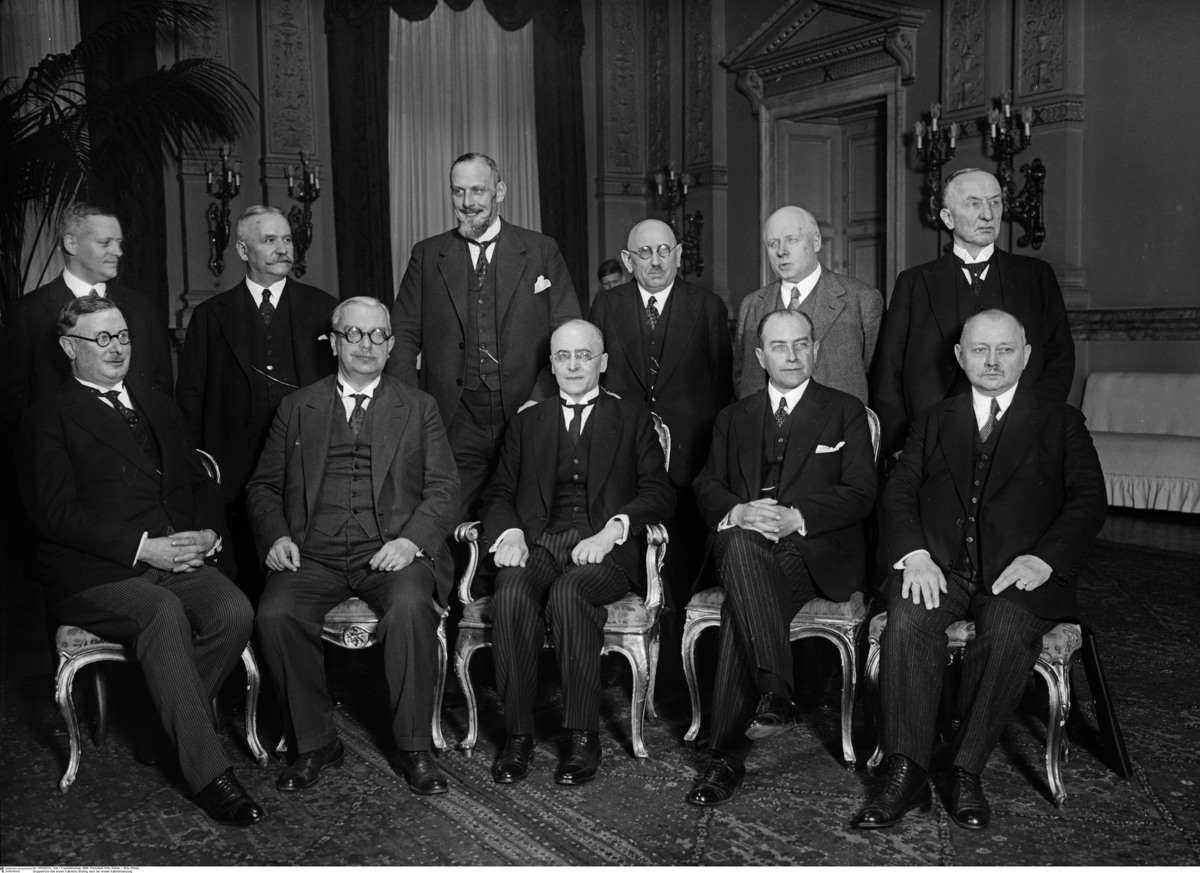
This photo taken the day the new government was formed shows the
cabinet ministers. Sitting from left to right: Josef Wirth (Domestic),
Hermann Dietrich (Commerce, Vice Chancellor), Chancellor Heinrich
Brüning, Julius Curtius (Foreign), Georg Schätzel (Post Office).
Standing from left to right: Gottfried Reinhold Treviranus (Occupied
Territories), Martin Schiele (Food and Agriculture), Johann Viktor Bredt
(Justice), Adam Stegerwald (Labor), Paul Moldenhauer (Finanzen), Theodor
von Guérard (Transportation)