Source
Source: From: Bruno Schwan, Die Wohnungsnot und das Wohnungselend in Deutschland. Berlin, 1929.
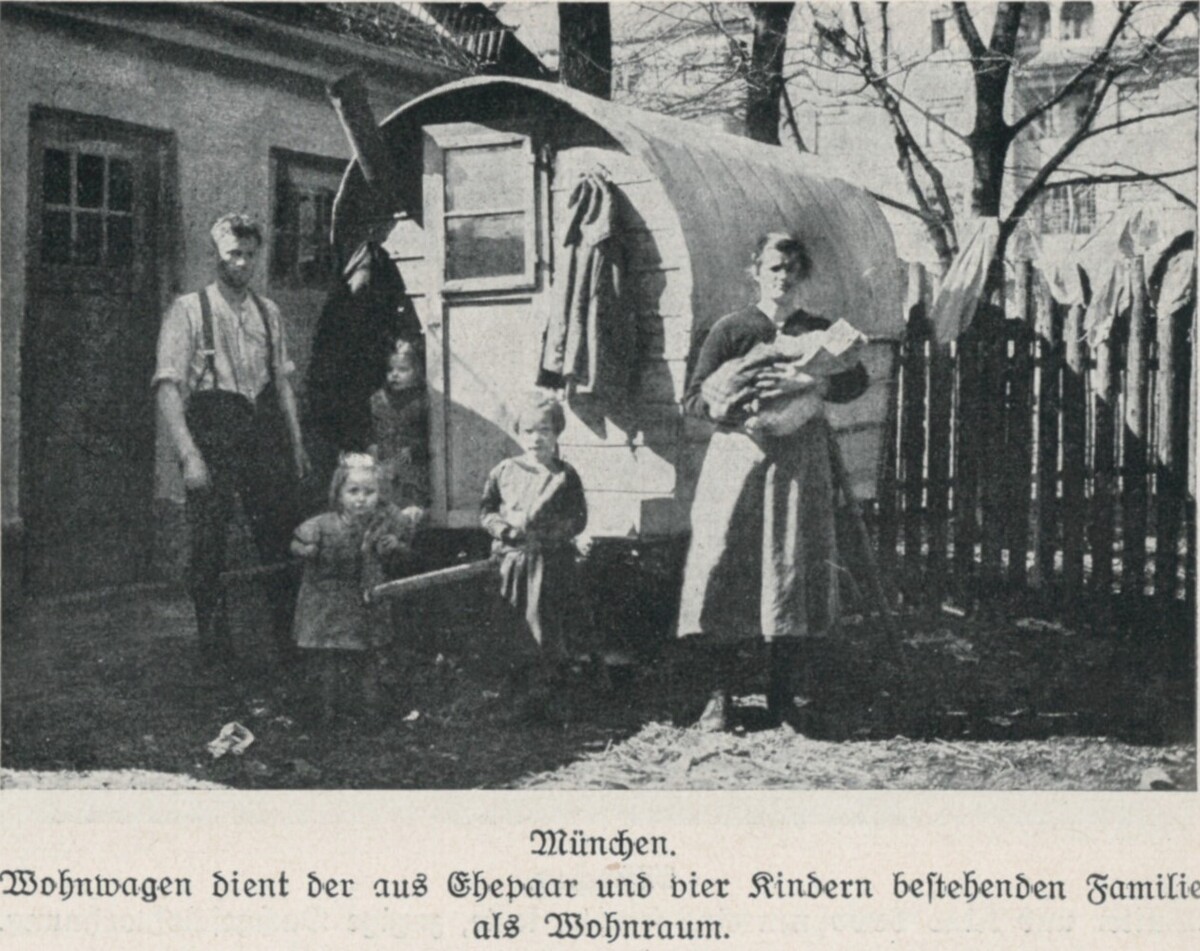
Article 155 of the Weimar Constitution formulated the government’s goal of “ensuring every German a healthy home and all German families, especially those with many children, a residential and economic homestead appropriate to their needs.” Accordingly, social housing projects were implemented from the mid-1920s to alleviate the housing shortage that had existed since the nineteenth century, particularly in urban working-class neighborhoods. Hyperinflation and the global economic crisis, however, dealt a blow to publicly financed housing construction, and mass unemployment meant that many impoverished people in both urban and rural areas became homeless. The 1927 housing census showed that at least one million households in Germany did not have their own home. This image was taken in Munich and shows a working-class couple and their children living in a caravan.
The image was included in a publication titled Die Wohnungsnot und das Wohnungselend in Deutschland [The Housing Shortage and Dire Living Conditions in Germany], which was published in 1929 by the German Association for Housing Reform under its managing director Bruno Schwan. The association was committed to improving the housing conditions of workers in particular and called for government measures to promote housing construction instead of leaving it to private developers alone, as had been the practice during the Kaiserreich period. Schwan and his colleagues had traveled to 150 German cities, towns and communities and documented the cramped and often unhealthy living conditions they found all across Germany.
Source: From: Bruno Schwan, Die Wohnungsnot und das Wohnungselend in Deutschland. Berlin, 1929.