Source
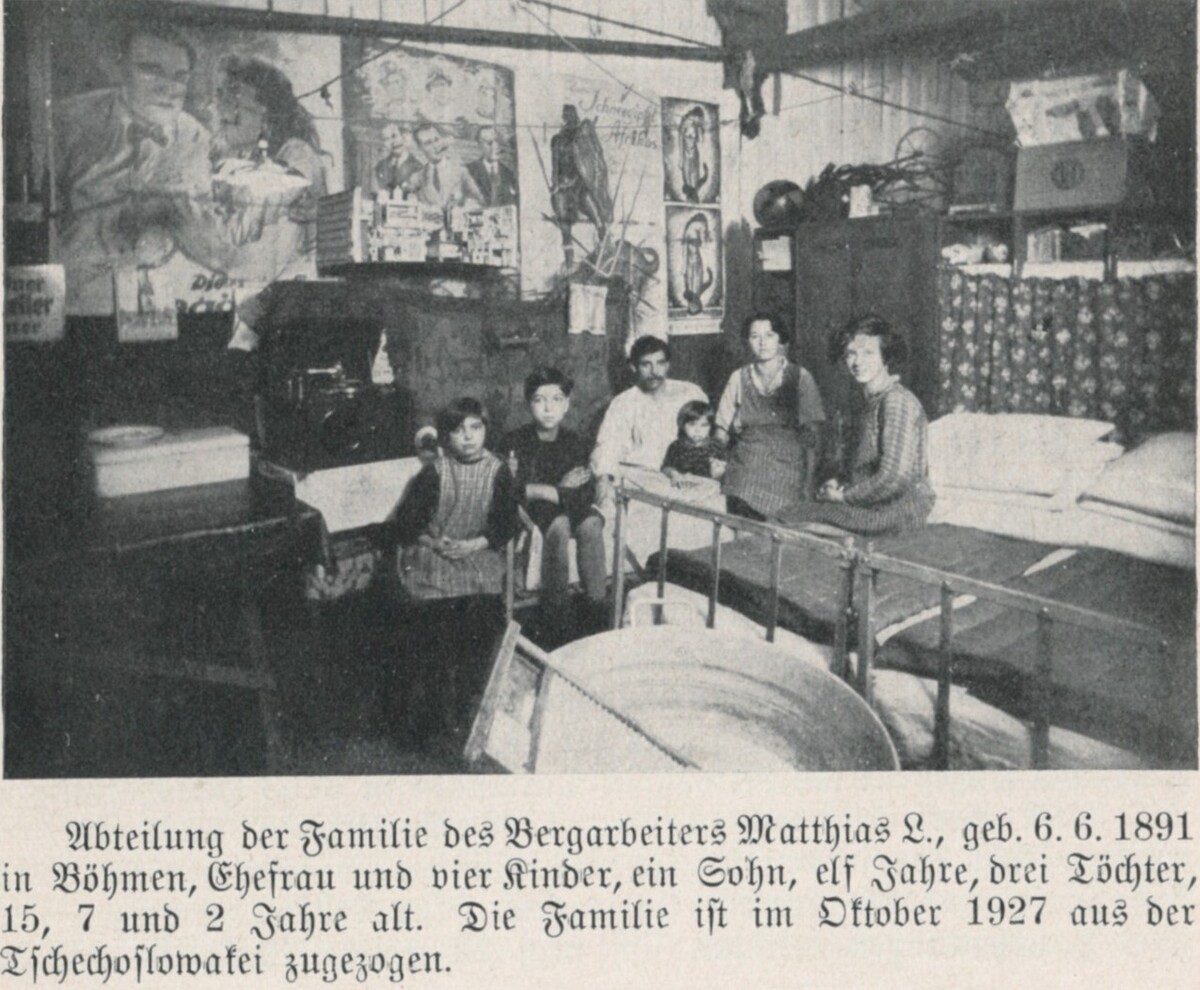
Source: From: Bruno Schwan, Wohnungsnot und Wohnungselend in Deutschland, Berlin, 1929.
This picture was taken inside accommodations for immigrant miners and
their families in Oelsnitz in the Vogtland region of Saxony. It shows a
family of six who had immigrated two years earlier from what was then
Czechoslovakia. The family shared a single room for living and sleeping
in these residential barracks, whose individual living units were only
separated by metal cabinets. The Weimar Republic’s immigration policy
was very restrictive, but since there was an acute labor shortage,
especially in industry and agriculture, companies could apply for the
employment of foreign workers if no domestic workers were available.
Most of these labor migrants came from Czechoslovakia, Poland, and
Austria. The Reichsanstalt für
Arbeitsvermittlung [National Agency for Labor Placement], which was
responsible for their recruitment and placement, unofficially pursued a
policy of prioritizing the recruitment of ethnic German
migrants.
The photo is taken from the publication
Die Wohnungsnot und das Wohnungselend in
Deutschland [The Housing Crisis and
Dire Living Conditions in Germany], which was published in 1929 by
the German Association for Housing Reform under its executive director
Bruno Schwan. The association was committed to improving the living
conditions of workers in particular and called for government measures
to promote housing construction instead of leaving it to private
developers alone, as had been the practice during the
Kaiserreich period. Schwan and his
colleagues had traveled to 150 German cities, towns and communities and
documented the cramped and often unhealthy living conditions they found
all across Germany.
Source: From: Bruno Schwan, Wohnungsnot und Wohnungselend in Deutschland, Berlin, 1929.