Women comprised a majority of the German electorate throughout the
entirety of the Weimar Republic, and parties across the political
spectrum certainly wanted to appeal to female voters. Most parties
continued to make those appeals using images of men, however. Election
posters from 1919 to 1932 still predominantly featured the faces of male
national party leaders, for instance; or a generic male worker, soldier,
or farmer; or even just a clearly male body part, such as a bicep or a
gripping hand.
A few parties, such as the Social Democrats (SPD) and the German
Democrats (DDP), seem to have featured women more regularly and
prominently in their election posters, and all parties seem to have
increasingly used female figures in their election advertising by the
1930s. Such generalizations remain somewhat tentative, though, given
that local party offices also produced a vast and diverse number of
posters, and that the distribution of different poster designs varied
widely. The famous and widely circulated photographs of campaign posters
crowding Berlin’s ubiquitous advertising columns (Litfaßsäule) at
election time have given historians some indication of the circulation
and popularity of individual poster designs in the capital city, but
this may not have reflected circulation in regional cities, let alone in
rural areas.
Still, a comparison of selected posters from different political
parties in early 1930s that featured women can yield suggestive
observations. This grouping of posters from the 1930 and 1932 election
campaigns highlights some starkly contrasting approaches to depicting
women.
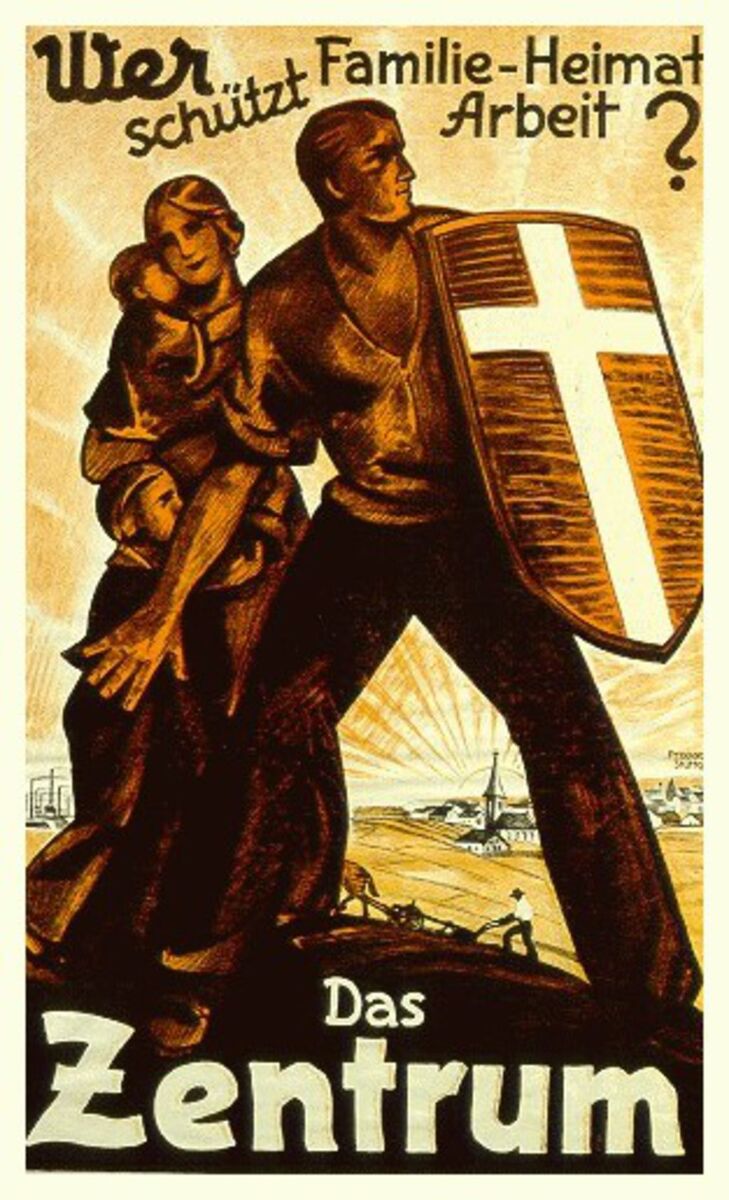
A 1930 poster for the Catholic Center Party (Zentrum) bore the
message “Who is protecting family, home, and work?,” and it featured the
woman as a mother who depended on the protection of a man carrying the
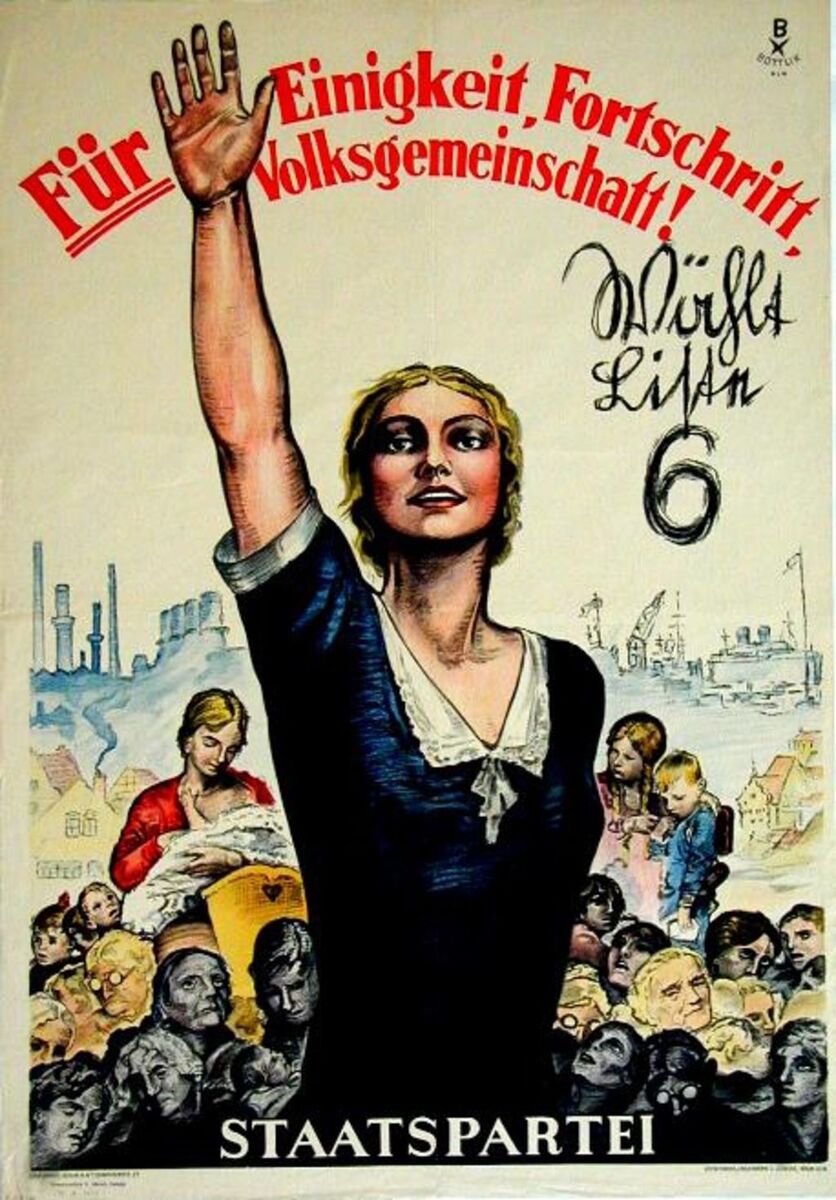
shield of the Catholic Center party. A 1930 poster for the German State
Party (Deutsche Staatspartei, DStP) similarly presented the woman as a
mother, at least in two of the background images, but these mothers did
not visibly rely on a male defender. Moreover, the featured female
figure was not marked as a mother at all and could easily have been
perceived by viewers as a career woman. Although the State Party had
charted a markedly conservative path in 1930, after it had formed from
of a merger between the liberal DDP and a right-wing association, the
central figure reflected, perhaps, a lingering trace of the party’s
liberal legacy. The message “For unity, progress, [ethnic] people’s
community!” also contained both a nod to its liberal branch, with the
word “progress,” and to its conservative one, with the explicit
reference to ethnic nationalism.
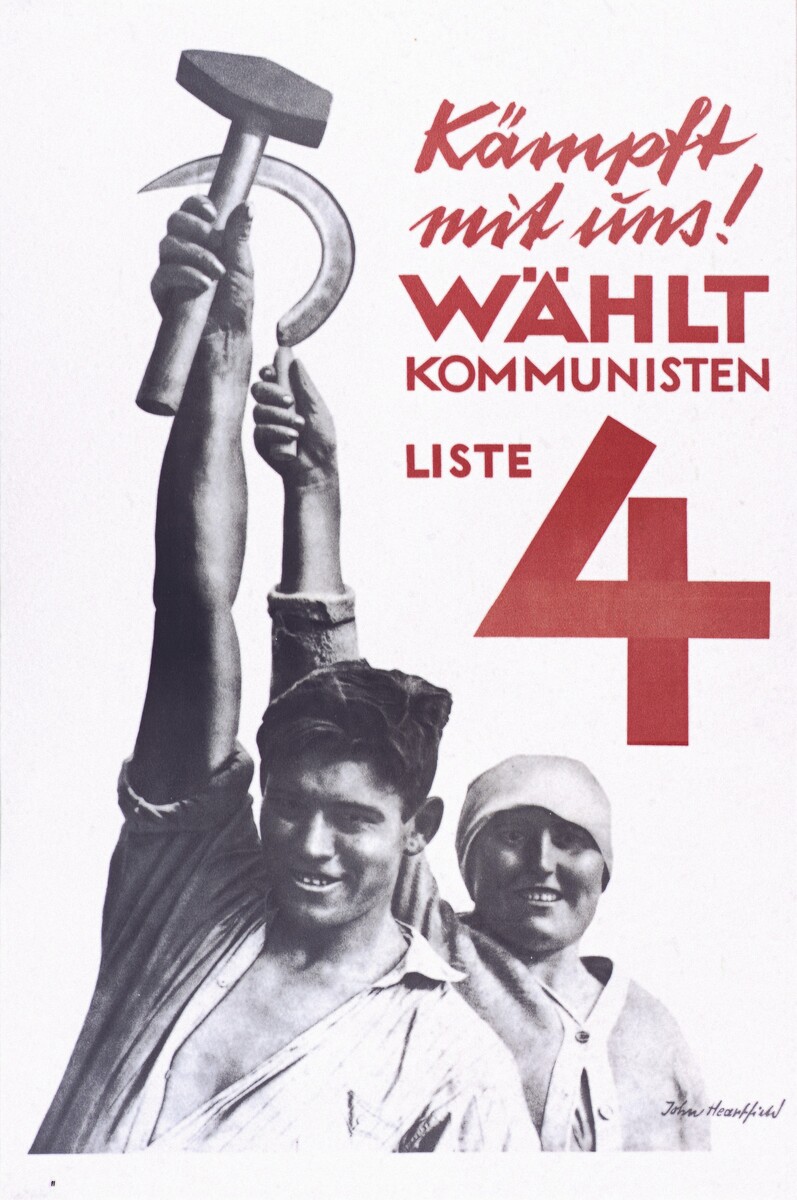
A 1930 poster for the Communist Party (KPD), which bore the message,
“Fight with us!,” depicted a female agricultural worker carrying a
sickle, but she stood behind the male worker holding up a hammer, who
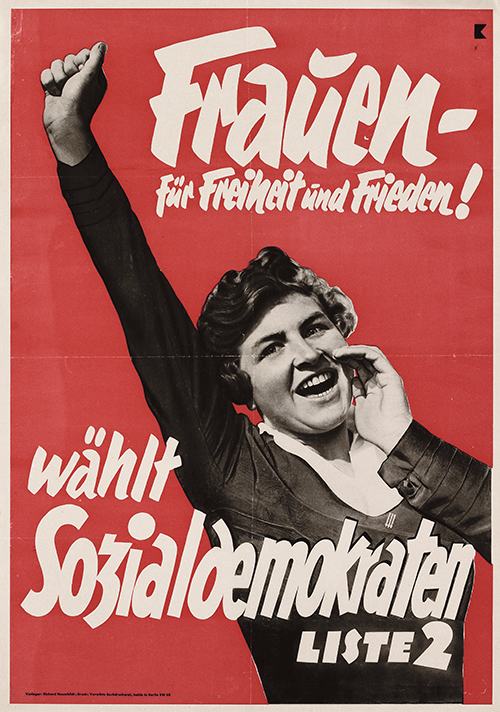
occupied the poster’s spotlight. The SPD produced a poster for the 1932
election that—alone among the examples here—presented the woman on her
own, without a man or a family behind, beside, or in front of her. The
straightforward message “Women—for Freedom and Peace! Vote for the
Social Democrats” made the appeal to women explicit. The woman appeared
especially confident and even joyous—as did, perhaps to a lesser degree,
the women in the KPD and DStP posters. Given that the 1930 elections
took place in September, over ten months into the economic depression,
such optimistic images sought to project hope amidst the increasing
hardships.
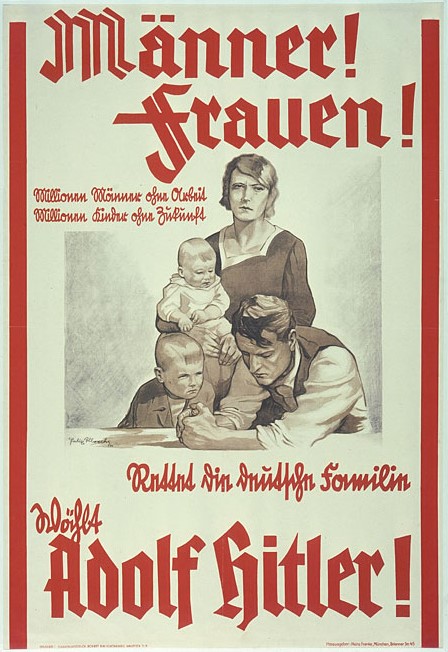
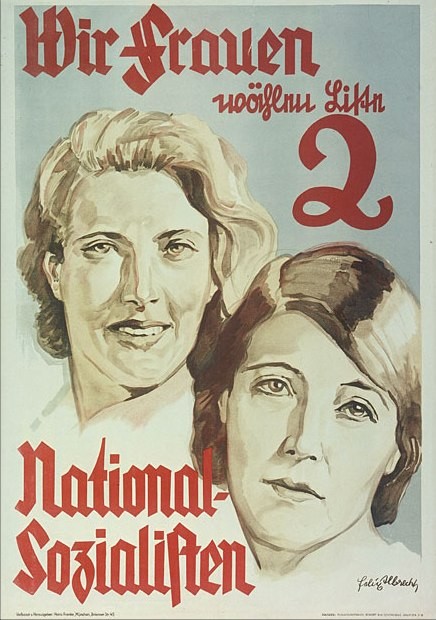
Finally, the two 1932 posters for the National Socialist Party
(NSDAP)—one from the April Presidential election, which Hitler lost to
Hindenburg; and one from the July Reichstag election, in which the Nazis
emerged as the most successful party by far, attracting over one-third
of the electorate—showed two different approaches by the Nazis to
depicting and appealing to women. The poster for the presidential
election featured the woman as a mother, but, unlike the Center Party
poster from 1930, she did not seem to rely on the protection of her
husband. Instead, she stared at the viewer with what looked like grim
determination, and her husband’s downcast gaze suggested that this woman
played the protector role at least as much as he did. The poster
nevertheless clearly ascribed to her a position in the home and caring
for her family, since only the millions of men (“without work”) and
millions of children (“without a future”) have, ostensibly, experienced
a status change as a result of the economic depression. By contrast, the
NSDAP election poster for the national elections two months later
appealed to women not as mothers, but as voters who had, presumably, a
full range of political interests. Like the SPD, KPD, and DStP posters,
these two figures appeared confident and energized.
Historians have done a lot of research in recent years on the visual
imagery of election campaigns in the Weimar Republic, and they continue
to debate and to further explore the representativeness of various
visual tropes. These six posters, from roughly the same time period,
make no claim to representativeness, but they at least offer a small
visual sampling of how Weimar Germany’s political parties framed at
least some of their appeals to voting female citizens.