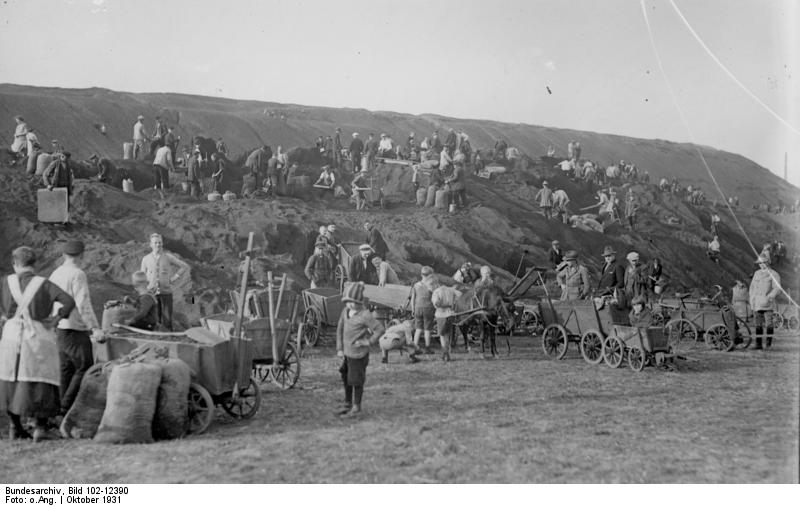
Abstract
By mid-1932, almost half of the population in the mining town of
Herne was dependent on some form of public welfare. Committees of the
unemployed were formed to help manage and distribute resources. These
committees were largely controlled by the Communist Party
[Kommunistische Partei Deutschlands
or KPD], which had recruited heavily and gained support among the
unemployed in the Ruhr during the 1920s. The Nazi party gained some
backing in the Ruhr among unemployed miners and industrial workers; but
its support remained weakest among workers in working-class communities
with strong union or socialist traditions. Around the Constantine the
Great [Zeche Constantin der Große]
and Teutoburgia mines [Zeche
Teutoburgia], where levels of unemployment were especially high,
the Nazis won only 12 percent of the vote in the Reichstag election of
1932, whereas the Communists secured nearly 70 percent.