Source
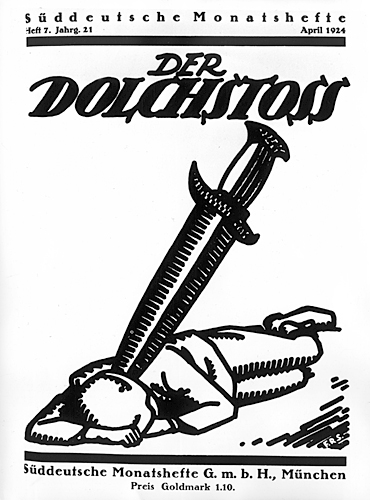
Source: Süddeutsche Monatshefte, title page, April 1924 (Heft 7, Jg. 21).
Although the Supreme Army Command (OHL) had to admit defeat in the fall of 1918 and therefore asked the Reich government to begin negotiations for an armistice, the OHL later tried to evade responsibility for the military defeat. Erich Ludendorff and Paul von Hindenburg blamed the political forces, citing, for example, the Reichstag’s peace resolution of 1917 and the munitions workers’ strike of 1918. On November 18, 1919, Hindenburg testified before the National Assembly’s committee of inquiry into the causes of the military collapse. In his testimony, he claimed that the German army had been “stabbed in the back” by the revolutionary forces on the home front. The political right seized on the stab-in-the-back legend to turn it into a theme for agitation against the political representatives of the Weimar Republic, especially politicians from the SPD and USPD. In the 1920s, the legend also took on an increasingly anti-Semitic tinge, as “international Jewry” was accused of having profited from Germany’s defeat in the war. This cover page of the Süddeutsche Monatshefte from April 1924 shows a soldier stabbed in the back by a disproportionately large dagger. The Süddeutsche Monatshefte was a cultural magazine published in Munich that had been spreading nationalist ideas since the First World War. They vehemently spread the stab-in-the-back legend, especially in the two issues of April and May 1924 known as the “Dolchstoßhefte”. In 1925, the publisher, Nikolaus Cossmann, initiated the so-called “stab-in-the-back trial” against the editor-in-chief of the social democratic Münchner Post, who had accused him of falsifying history. Among the witnesses who testified at the trial were Gustav Noske, Admiral von Trotha, Wilhelm Groener, Otto Wels and Philipp Scheidemann. In its verdict, the Munich District Court ruled in favor of Cossmann and sentenced the editor-in-chief of the Munich Post to a fine for libel. The trial received a great deal of press and public attention, which meant that Cossmann had achieved his aim of spreading the stab-in-the-back legend. In 1942, Cossmann, who was of Jewish descent, was deported to Theresienstadt while seriously ill, where he died that same year.
Source: Süddeutsche Monatshefte, title page, April 1924 (Heft 7, Jg. 21).
Bildarchiv Preußischer Kulturbesitz