Abstract
After the failed Hitler-Ludendorff Putsch of November 1923, Hitler
and his co-conspirators were put on trial in Munich. While the Weimar
government had sought to try Hitler and the other putschists before a
special Court for the Protection of the Republic in Leipzig
[Staatsgerichtshof zum Schutze der
Republik] in accordance with the Law for the Protection of the
Republic [Republikschutzgesetz], the
Bavarian state government was eager to try them in Bavaria. The Bavarian
government ultimately succeeded, and the trial was held before the
People’s Court [Volksgericht] in
Munich from February 26 to April 1, 1924. The
Volksgericht had been established in
1918 as a special court for the accelerated sentencing of certain
criminal offenses. Its proceedings were summary, and its decisions could
not be appealed. Charged with high treason, Hitler’s defense strategy
included a combination of dramatic courtroom oratory and nationalist
rhetoric, which garnered substantial public attention and sympathy. The
presiding judge conducted the trial in a manner that clearly benefitted
Hitler and the other defendants, giving Hitler the opportunity for
lengthy propaganda speeches. His courtroom appearance provided Hitler
with a prominent platform to articulate his political ideology and
grievances against the Weimar Republic, contributing to his rising
influence among the political right. His sentence to five years in
prison, the statutory minimum penalty, was very mild for a charge of
high treason, and he was released early on probation although he had a
previous conviction. As a foreign national, he would have been subject
to deportation according to the Law for the Protection of the Republic,
but the court expressly did not seek it. Erich Ludendorff was acquitted
while the other defendants received prison sentences between one and
five years. Both the Social Democratic and the liberal press criticized
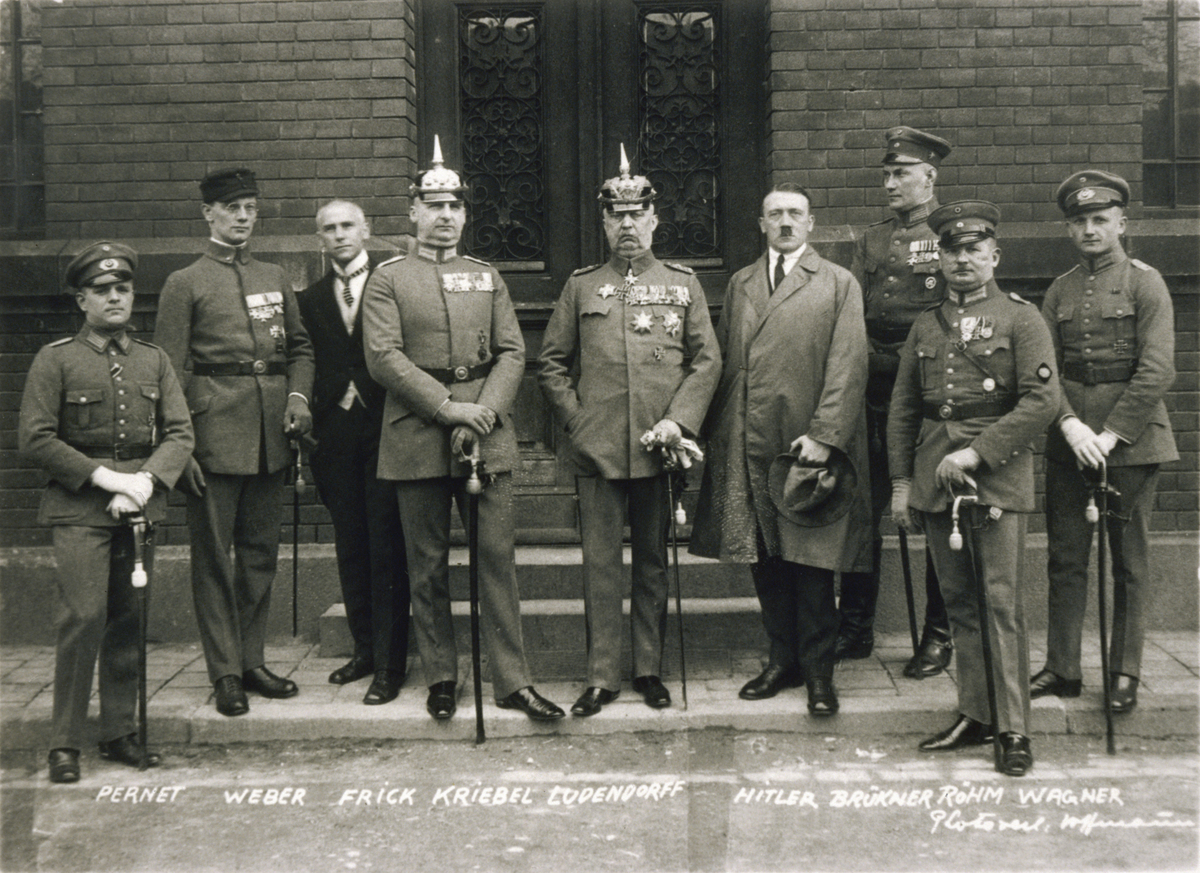
the trial and the lenient sentences as a farce. This photo by Heinrich
Hoffmann, who had documented the Hitler-Ludendorff Putsch and was to
become Hitler’s personal photographer, shows the defendants posing
defiantly for the camera. From left to right: Heinz Pernet, Friedrich
Weber, Wilhelm Frick, Hermann Kriebel, Erich Ludendorff, Adolf Hitler,
Wilhelm Brückner, Ernst Röhm, Robert Wagner.