Abstract
In Germany, politicians were unable to reconcile public demands for
the evacuation of the Rhineland with French and British insistence on
the prior settlement of reparations. The situation led to widespread
German disillusionment with Stresemann’s Locarno policy. As a result,
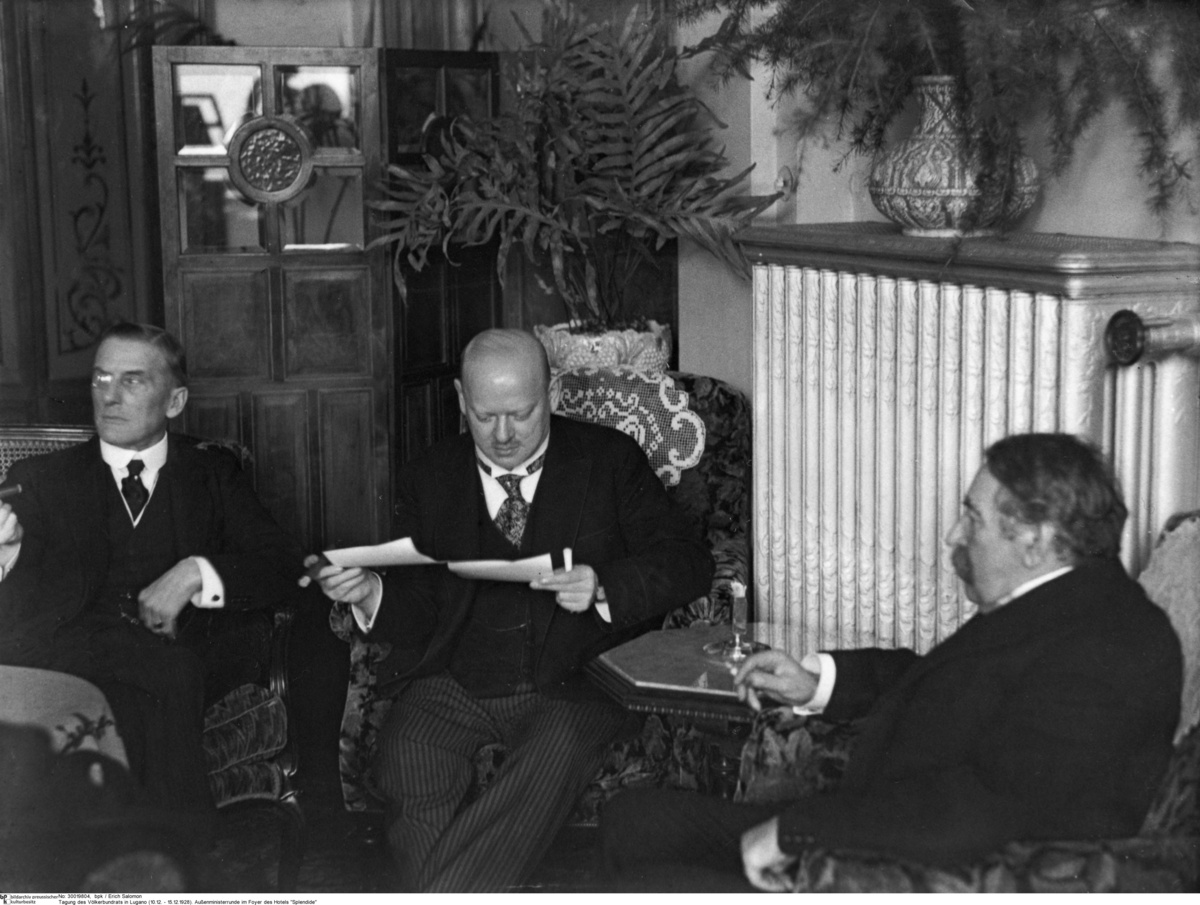
relations between treaty signatories Stresemann (center), Briand (left),
and Chamberlain (right) suffered as well. In consideration of
Stresemann’s deteriorating health, the three foreign ministers chose
Lugano, Switzerland, as the venue for continuing discussions of the
Rhineland evacuation and Germany’s final reparations settlement. Faced
with mounting criticism at home, Stresemann tried to use German
opposition to his policy to his advantage. In Lugano, he told Briand and
Chamberlain that the continuation of his policies (and of the Müller
government in which he served) depended on immediate concessions and
assurances from the Allies. In the end, he received none of the
concessions or assurances he asked for. The photograph shows Stresemann
reviewing photos taken by Erich Salomon (1886-1944), a pioneering news
photographer credited with inventing the “photo op.” Briand referred to
Salomon as “the king of indiscretion” [Le
roi de indescrets].