Source
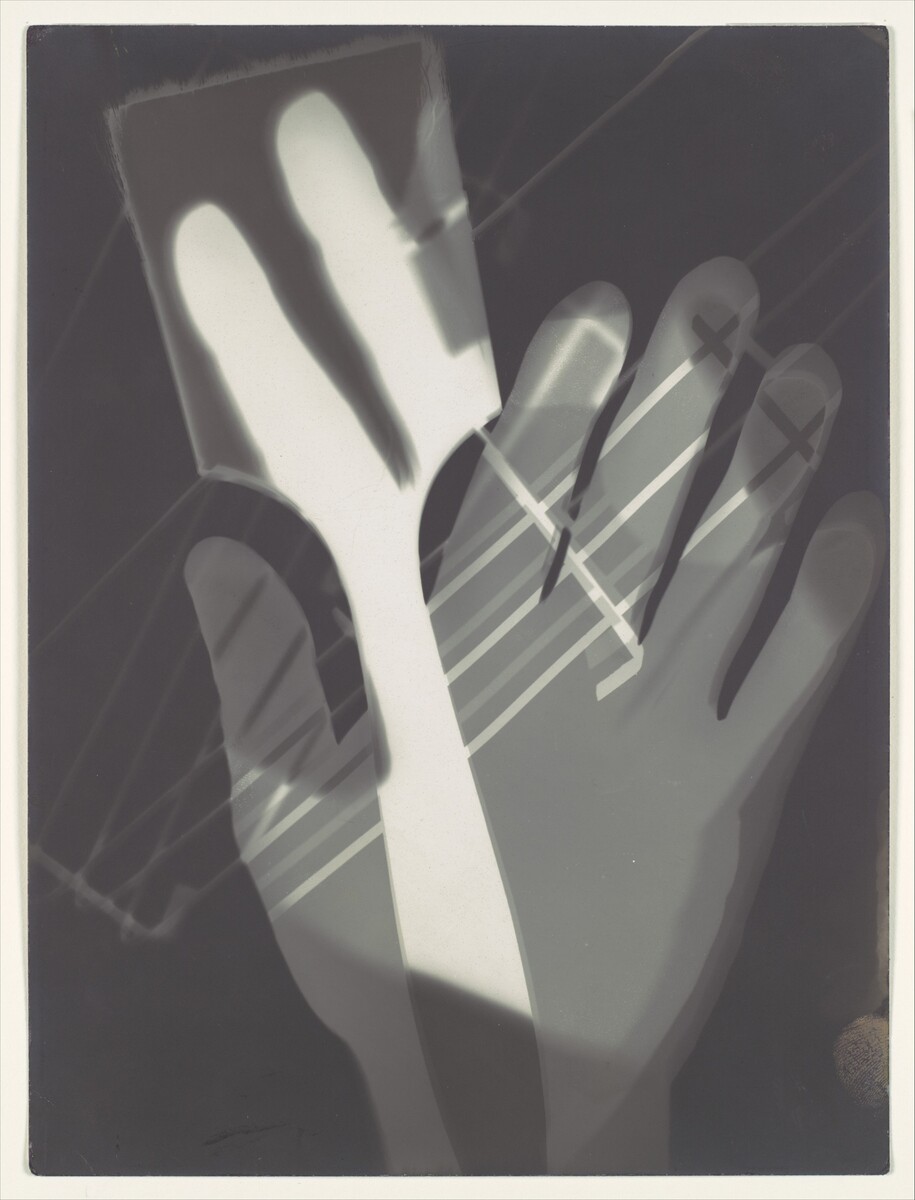
Source: Lázló Moholy-Nagy, Photogram, Silver gelatin print, 1926. Metropolitan Museum of Art. Wikimedia Commons, https://commons.wikimedia.org/wiki/File:Fotogramm_MET_DP111649.jpg
Like Walter Gropius and many others, László Moholy-Nagy sought to break down the barriers between life and art, as well as among all the various genres and media. In line with the Bauhaus ethos of finding beauty in compositional materials, Moholy-Nagy argued fervently that photography was about the manipulation of light, and hence the art form most suited to the modern age. The photograms he produced in the mid-1920s epitomized this concept. Photograms were camera-less images created by a chemical process of layering different exposures on light-sensitive paper. They allowed Moholy-Nagy to explore the optical and expressive properties of light. In this photogram from 1926 he used his hand and a paintbrush.
Source: Lázló Moholy-Nagy, Photogram, Silver gelatin print, 1926. Metropolitan Museum of Art. Wikimedia Commons, https://commons.wikimedia.org/wiki/File:Fotogramm_MET_DP111649.jpg
