Source
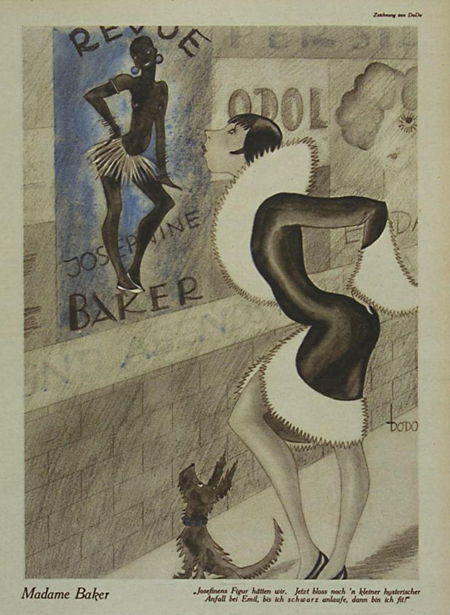
Source: Drawing by DoDo (Dörte Wolff), Ulk, no. 46, November 16, 1928.
Except for the small number of Germans who had settled or visited the colonies before 1918, most Germans had only encountered Africans in the Völkerschauen, the traveling carnival exhibits that took a paternalistic view of black Africans and their “primitive” customs and culture. But when African-American and French colonial soldiers arrived on World War I battlefields, all of that changed, and after the war, the German fascination with blacks was generally accompanied by patronizing and racist attitudes. Josephine Baker, a black American performer whose Revue nègre created a sensation in Berlin and all over Europe, was seen as the embodiment of both an unspoiled, primitive naturalism and urban modernity. This caricature of a white German woman aspiring to look like Baker appeared in Ulk, a satirical magazine published by Rudolf Mosse from 1872-1933. The drawing is by artist Dörte Wolff (who signed her artworks DoDo). The caption reads: “I already have Josephine’s figure. Now it just takes one of Emil’s hysterical fits, until I’m black and blue, and I’ll be there.”
Source: Drawing by DoDo (Dörte Wolff), Ulk, no. 46, November 16, 1928.