Source
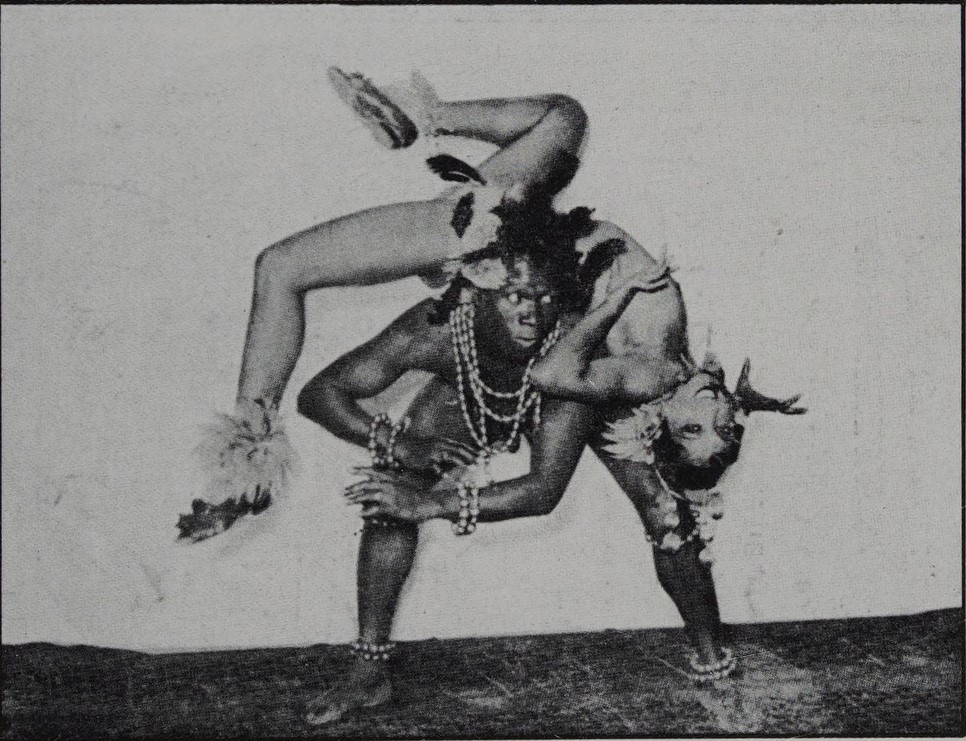
Source: Josephine Baker and Joe Alex performing the "Dance Sauvage," from Bryan Hammond and Patrick O'Connor, Josephine Baker, London: Jonathan Cape, 1988, p. 19.
Theatergoers in Berlin and other large German cities in the mid-1920s flocked to see a number of live performances by black artists on stage. In Spring 1925, the “Chocolate Kiddies,” a three-act jazz revue that featured music, dancing, and performances by African-American artists, including the singer Adelaide Hall, played to enthusiastic audiences in Hamburg and Berlin. In 1925/26, the St.-Louis-born black singer and dancer Josephine Baker took Berlin by storm, when she and the all-black Revue Nègre cast performed their show (which had premiered in Paris in October 1925) in the German capital. Baker’s high-voltage, exaggerated dances brought audiences to their feet, and the German cultural journal Der Querschnitt wrote: “Her tush, with all due respect, is a chocolate pudding in motion.” Baker’s most famous moment in that show, the “Danse Sauvage,” featured her and the Senegalese dancer Joe Alex engaged in an erotically charged and acrobatic intertwining of their bodies. (Baker first performed her legendary banana-skirt dance after she had returned to Paris, where she had lived since 1924.) The Berlin director Max Reinhardt tried to lure Josephine Baker to stay in the capital for a longer engagement, but the Varieté Folies Bergère made her an even more attractive counteroffer, and she returned to France by late winter 1926.
While upper- and upper-middle-class German theatergoers swooned to the performances of Baker and others, a much broader socio-economic cross section of the population had the opportunity to see exoticized black bodies on display in the popular Völkerschauen at the time, too.
Source: Josephine Baker and Joe Alex performing the "Dance Sauvage," from Bryan Hammond and Patrick O'Connor, Josephine Baker, London: Jonathan Cape, 1988, p. 19.
Bryan Hammond collection