Abstract
After dropping out of law school, Josef Terboven (1898-1945) had
completed a bank apprenticeship and was unemployed from 1925. He had
joined the NSDAP as early as 1923 and had participated in the
Hitler-Ludendorff Putsch in November of that year. He would become
leader of the SA in Essen and founded a local branch of the NSDAP there
in 1925. From 1928, he served as Gauleiter [district leader] of Essen.
In addition to the city itself, the Essen district comprised the western
Ruhr area, including the cities of Duisburg, Oberhausen and Mühlheim, as
well as some rural communities on the Lower Rhine. Until Hitler’s rise
to power, however, the NSDAP was unable to achieve any significant
electoral success here, as the industrial Ruhr area was strongly
influenced by the labor movement and the rural, Catholic constituencies
on the Lower Rhine predominantly voted for the Catholic Center Party.
Nonetheless, Terboven was elected to the Reichstag in 1930. After the
Nazis came to power, he continued his career within the Nazi regime and
during the Second World War became Reichskommissar of occupied Norway,
where he established a ruthless system of economic exploitation and
political repression.
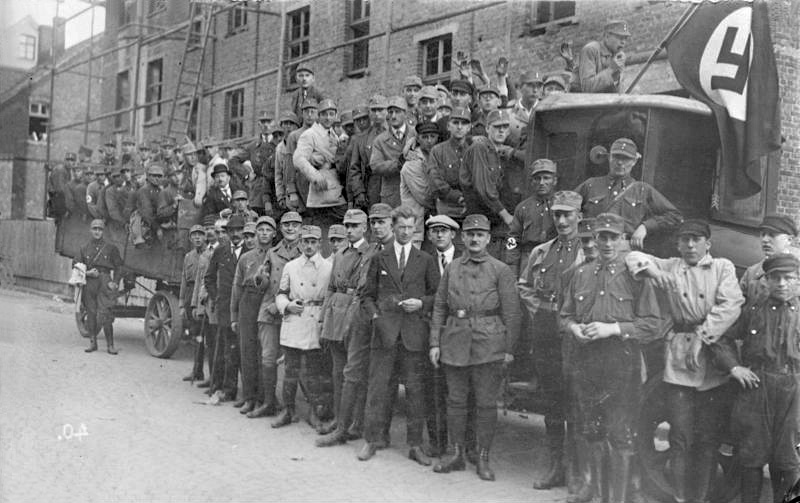
This photograph, taken in July 1926, shows Terboven (front row, in
civilian clothes) with members of the Essen SA on the way to the NSDAP
Reich Party Congress in Weimar. This was the second party conference of
the Nazis and the first large gathering of the NSDAP since Hitler’s
early release from prison in December 1924 and the reestablishment of
the party in February 1925. It took place in Weimar from July 3-4, 1926.
Since Hitler was still banned from public speaking in Bavaria at the
time, the conference was moved to Weimar in Thuringia.