Source
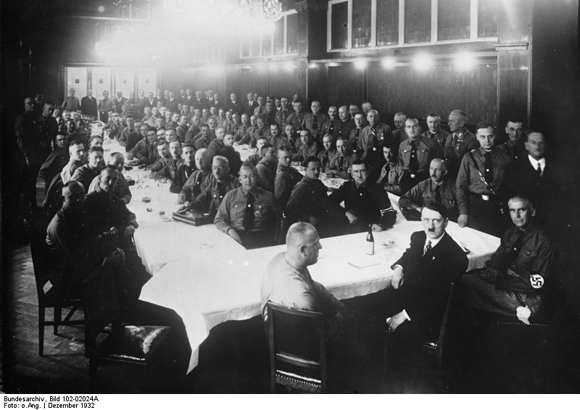
Source: NSDAP Reichstag parliamentary faction, December 1932. Photographer: Georg Pahl. Bundesarchiv-Bildarchiv, picture number: 102-14122.
In the elections on July 31, 1932, the NSDAP became the strongest parliamentary group in the Reichstag with 37.3% of the vote, but did not achieve an absolute majority. In the new elections in November 1932, which Hindenburg called after the Reichstag was dissolved again, the NSDAP lost 4% of the vote and 34 seats, but remained the strongest parliamentary group in the Reichstag with 33.1%. This photo shows one of the last meetings of the NSDAP Reichstag parliamentary group under the leadership of Adolf Hitler (center) in December 1932. Sitting to Hitler's right is the chairman of the NSDAP Reichstag parliamentary group, Wilhelm Frick, to his left is Gregor Strasser, head of the Reich organization of the NSDAP and already “on leave” in December 1932 in the wake of the “Strasser crisis”.
Hitler and Strasser had a volatile relationship, characterized by political and ideological differences and personal rivalry. After Kurt von Schleicher, whom Hindenburg had appointed Reich Chancellor on December 3, offered Gregor Strasser the post of Vice-Chancellor, the conflict between the NSDAP leaders escalated. Determined to maintain his power and prevent a split in the party, Hitler isolated Strasser from the party, sent him on forced leave and forced him to resign from all posts. In March 1933, Strasser gave up his seat in the Reichstag. In June 1934, he was arrested and murdered by the Gestapo during the Röhm Putsch.
Source: NSDAP Reichstag parliamentary faction, December 1932. Photographer: Georg Pahl. Bundesarchiv-Bildarchiv, picture number: 102-14122.
Bundesarchiv