Abstract
Horst Wessel (1907-1930), the son of a Protestant pastor from a
middle-class background, had joined the Nazi Party in 1926 while
studying law. However, he dropped out of university two years later and
scraped a living with odd jobs. Supported by Joseph Goebbels, the NSDAP
Gauleiter of Berlin, he quickly rose through the ranks of the SA. The SA
storm troop he led in Berlin’s working-class neighborhood Friedrichshain
was known as a brutal gang of thugs that sought confrontation with
communist and social-democratic groups. In January 1930, Wessel was
wounded with a gun in his apartment by a criminal who was also a member
of the KPD, and later died from his injuries. It is unclear whether the
assault was politically motivated or had a private background.
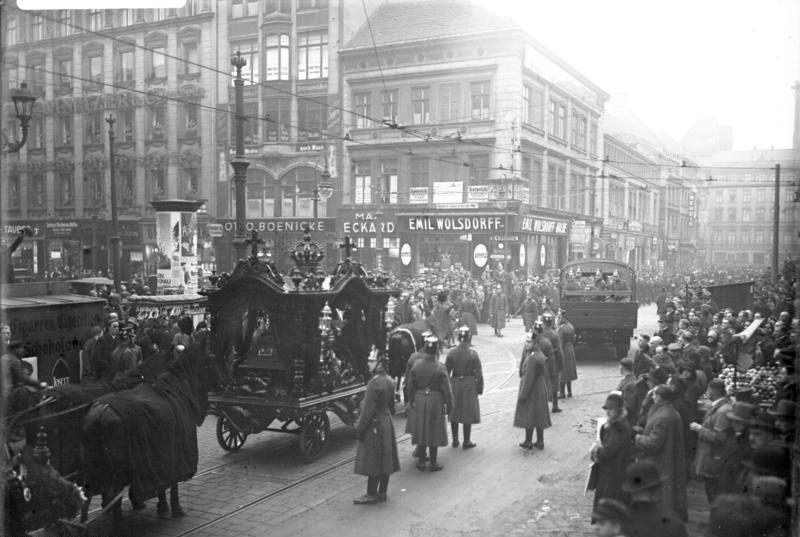
Regardless, Nazi propaganda stylized Wessel as a martyr to the National
Socialist cause. His funeral, which had to be guarded by the police, was
exploited by the Nazis for propaganda purposes and recorded on film. A
martial song written by Wessel was named after him and declared the
party anthem. After the Nazis came to power, streets and buildings were
named after him. This photograph by press photographer Georg Pahl shows
the funeral procession passing by numerous onlookers under police
protection.