Abstract
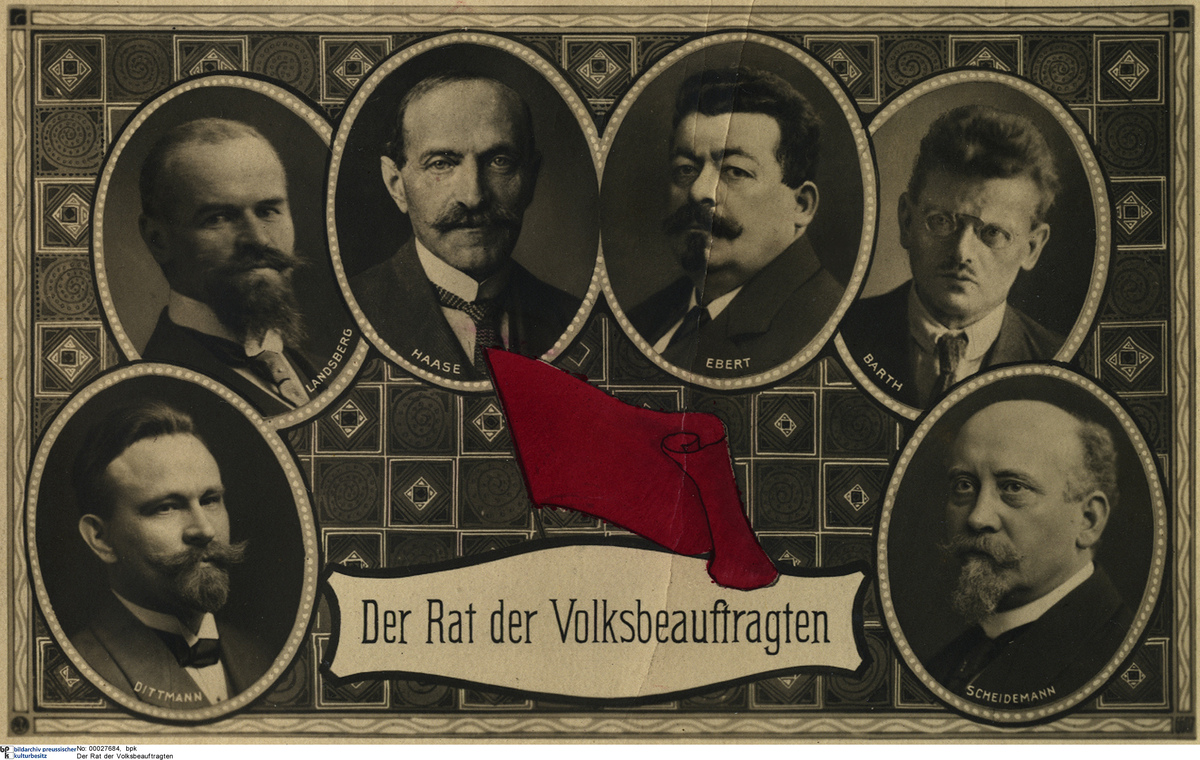
On November 10, the SPD and USPD formed the First Council of People’s
Deputies, a body in which each party had an equal number of members,
including in the joint chairmanship of Friedrich Ebert and Hugo Haase.
This postcard shows the council’s six members. From left to right, they
are Wilhelm Dittmann (USDP), Otto Landsberg (SPD), Hugo Haase (USPD),
Friedrich Ebert (SPD), Emil Barth (USPD), and Philipp Scheidemann (SPD).
The revolutionary red flag contrasts with the otherwise black-and-white
postcard. The Council of People’s Deputies had wide-ranging powers and
took on the most urgent governmental tasks, for example, demobilization
after the armistice was signed. It gained the support of the military’s
leadership by concluding a pact with the army’s supreme headquarters
(OHL), which gave the latter autonomy in military affairs. Soon,
however, the SPD and USPD split because the latter rejected a national
constitutional assembly in favor of a socialist republic organized on
the basis of the revolutionary councils (often translated as “soviets”
in English). After a socialist uprising during the Christmas Rebellion
was put down on Ebert’s orders, the USPD council members left their
positions and were replaced by two SPD deputies, Gustav Noske and Rudolf
Wissell. Elections to the National Assembly were held on January 19,
1919, and that body replaced the Council of People’s Deputies. Picture
postcards had been a popular medium for political messaging under the
Kaiser. During the revolution, portraits of the main revolutionary
figures replaced those of the Kaiser and his family, as did images of
key revolutionary events, in order to underline the legitimacy of the
new government. Since these postcards were primarily destined for
postcard collections, many have been preserved.