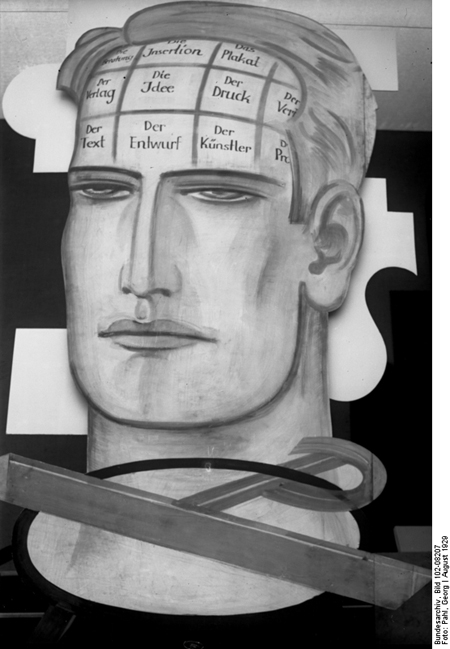
Abstract
Large advertising agencies such as the American firm J. Walter
Thompson entered the German marketplace in the mid-1920s and ushered in
a new view of advertising as a professional and systematic science. A
1929 trade publication described the industry as follows:
“Today, consulting a client no longer is about ingenious inspiration,
'original ideas,' tasteful opinions, artistic considerations, and the
like. The consultant is no longer the jack-in-the-box he used to be,
overflowing with imagination and impulsiveness. His successes must be
the result of study, for serving a customer does not mean offering
purely theoretical concepts. All success is based on careful calculation
and the ability to completely penetrate the specific consumer’s psyche.
[ . . . ] It involves the analysis of advertising materials, scientific
product testing, market research, organization, drawing and photography,
the assessment of results, text experts, printers, and production.”
From: Hans Wündrich-Meissen, "Aufgaben des Beraters," in
Die Reklame 22 (1929), pp.
445-46.