Abstract
After Kurt Eisner’s murder and the violence that followed, political
chaos predominated in Bavaria. Here, too, a conflict flared up between
supporters of a parliamentary republic and those who wanted a socialist
soviet republic (aka councils’ republic or
Räterepublik). Initially the Majority
Social Democrats around Minister-President Johannes Hoffmann seemed to
have gained the upper hand, but they were unable to stabilize the
political and economic situation. The radical left saw an opportunity
and proclaimed the Bavarian Soviet Republic on April 7, 1919. Supporters
of the minister-president attempted to violently suppress adherents of
the soviet republic, which radicalized things further and cost many
lives. Soldiers’ and workers’ councils declared a second, communist
soviet republic in the Hofbräuhaus. A Red Army was established, the
citizenry was disarmed, and political opponents were arrested. The
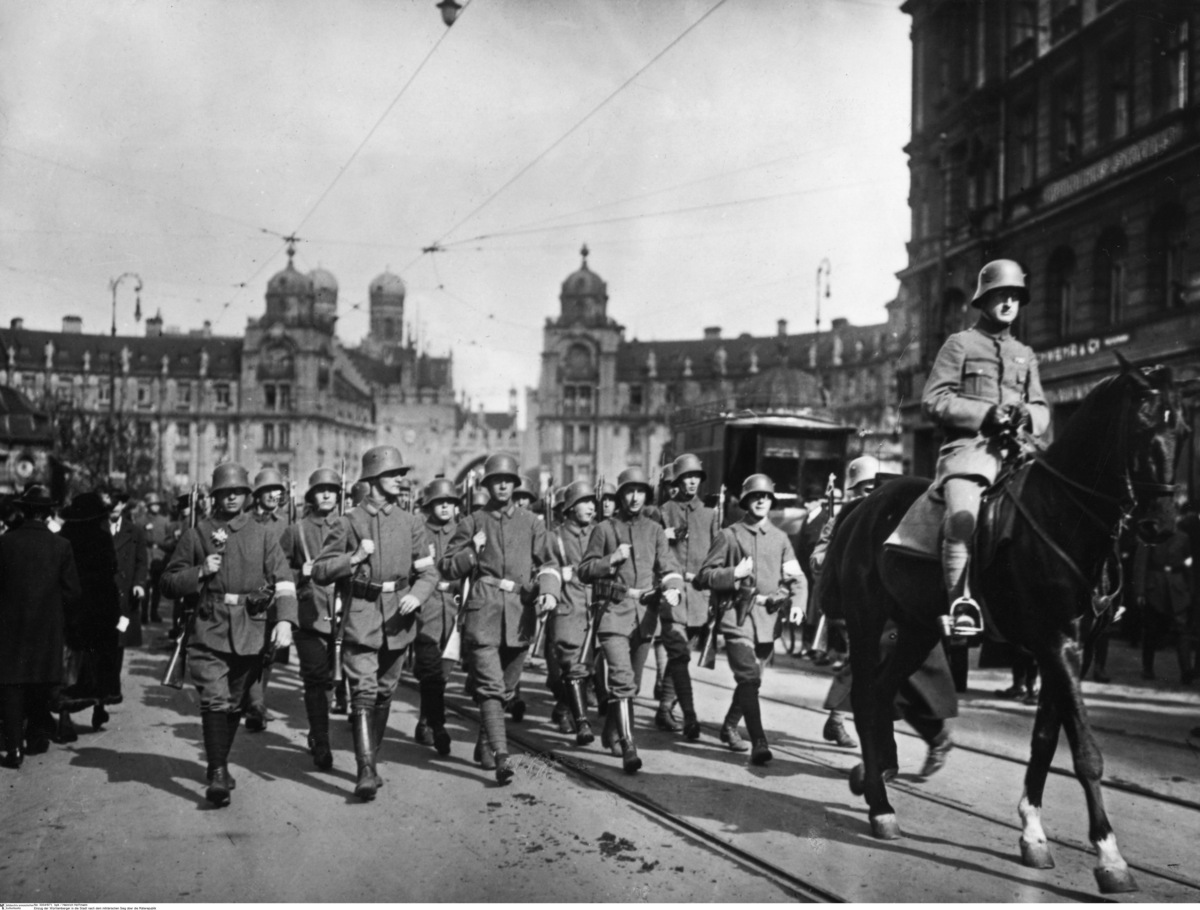
situation resembled a civil war in May, when Reichswehr and free corps
troops besieged Munich, toppled the communist government after days of
deadly conflict, and took control of Munich. This photograph from May
1919 shows Reichswehr soldiers marching through Munich after the
overthrow of the councils’ republic. That same month, a constitution was
proclaimed in Bavaria, but parliamentary democracy did not develop a
stronghold there. On the contrary, the region became a bastion of
antidemocratic, national-conservative, and völkisch groups in the period
following.