Abstract
In December 1918, the confrontation between the People’s Naval
Division and
the Committee of People’s Representatives took a violent turn in the
so-called Christmas Rebellion. Fighting occurred in the governmental
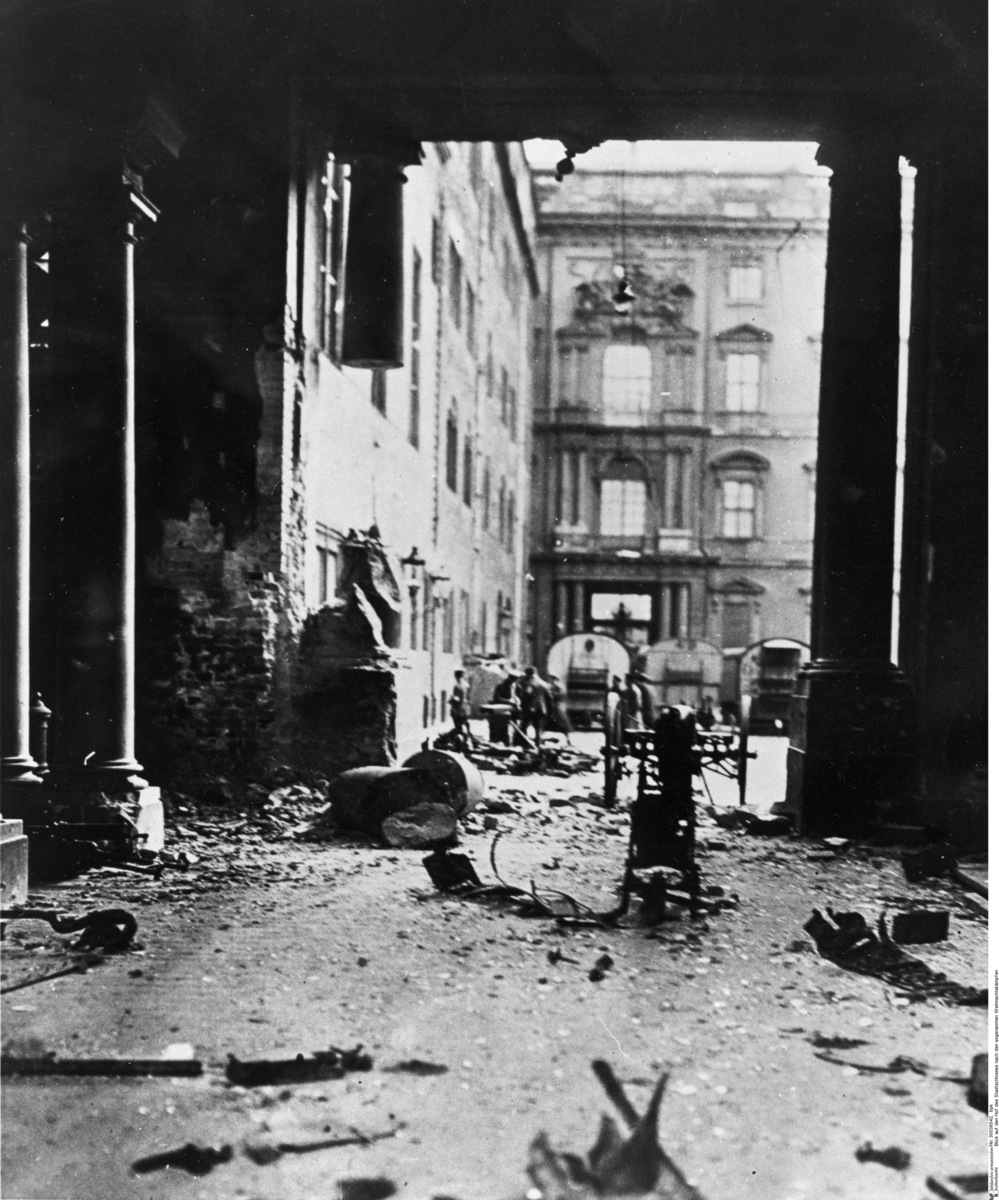
quarter of Berlin, devastating the Berlin Palace. The soldiers there had
refused to leave because they had not yet been paid, whereas the
People’s Representatives had accused the soldiers of stealing works of
art from the palace. This photograph shows the condition of the inner
courtyard after the fighting. The Reichswehr was forced to pull back,
and the palace was finally cleared, but the People’s Naval Division
continued to exist undiminished in size.
The Christmas Rebellion had grave political consequences. The USPD
left the Council of People’s Representatives in protest against that
body’s use of military force, fracturing the alliance between both
parties on the left. On top of that, the People’s Representatives now
supported the recruitment of so-called
Freikorps in order to guarantee
domestic security. The Freikorps were paramilitary units of World War
veterans recruited by Supreme Army Headquarters, largely privately
financed, and fundamentally nationalistic and anti-revolutionary. In
order to fight the spectre of Bolshevism, the Social Democrats entered a
dangerous alliance with anti-democratic forces.