Abstract
On January 11, 1923, five French divisions and a small number of
Belgian troops occupied the Ruhr region, the center of Germany’s heavy
industry. The occupation was prompted by the Allied Reparations
Commission’s finding that Germany was late in delivering reparations to
France. According to the Versailles Treaty, late or unfulfilled
reparations were liable to sanctions. The French government under
Minister President Poincaré was convinced that Germany was stalling out
of unwillingness to fulfill its obligations and thus decided to occupy
the Ruhr region as a security for outstanding deliveries of coal and
wood. The issue of reparations was important to France, not least
because France depended on German reparations in order to repay its own
war debt. The occupation met with resolute resistance both from the
German government and the local population. On the same day that the
occupation troops marched in, Reich President Ebert called for passive
resistance and ordered the immediate suspension of coal deliveries to
France and Belgium. The labor unions called a general strike, in which
postal and railroad workers also participated, meaning that the local
economy and transportation came to a standstill. Meanwhile, the German
government granted financial support to striking workers. In the end,
the policy of passive resistance failed due to the unstoppable inflation
and the attendant suffering of the population. Only once American
intervention promised a more realistic schedule for the fulfillment of
reparations, as well as an end to the Ruhr region’s occupation did the
situation quiet down. The occupation forces left the region in June 1925
as scheduled.
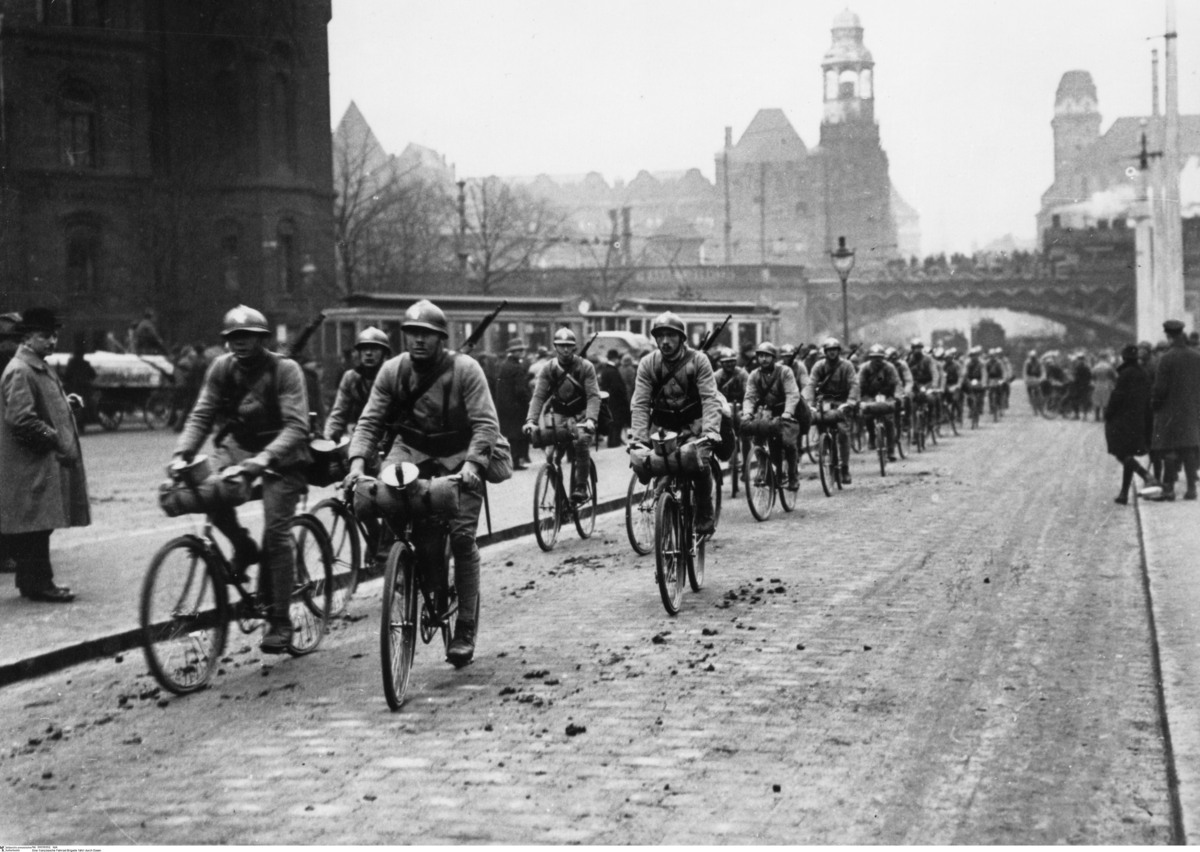
This photo shows a bicycle brigade of French occupation troops riding
through the occupied city of Essen, one of the Ruhr region’s main
industrial centers. A total of 60,000 French soldiers were deployed to
the Ruhr region.