Abstract
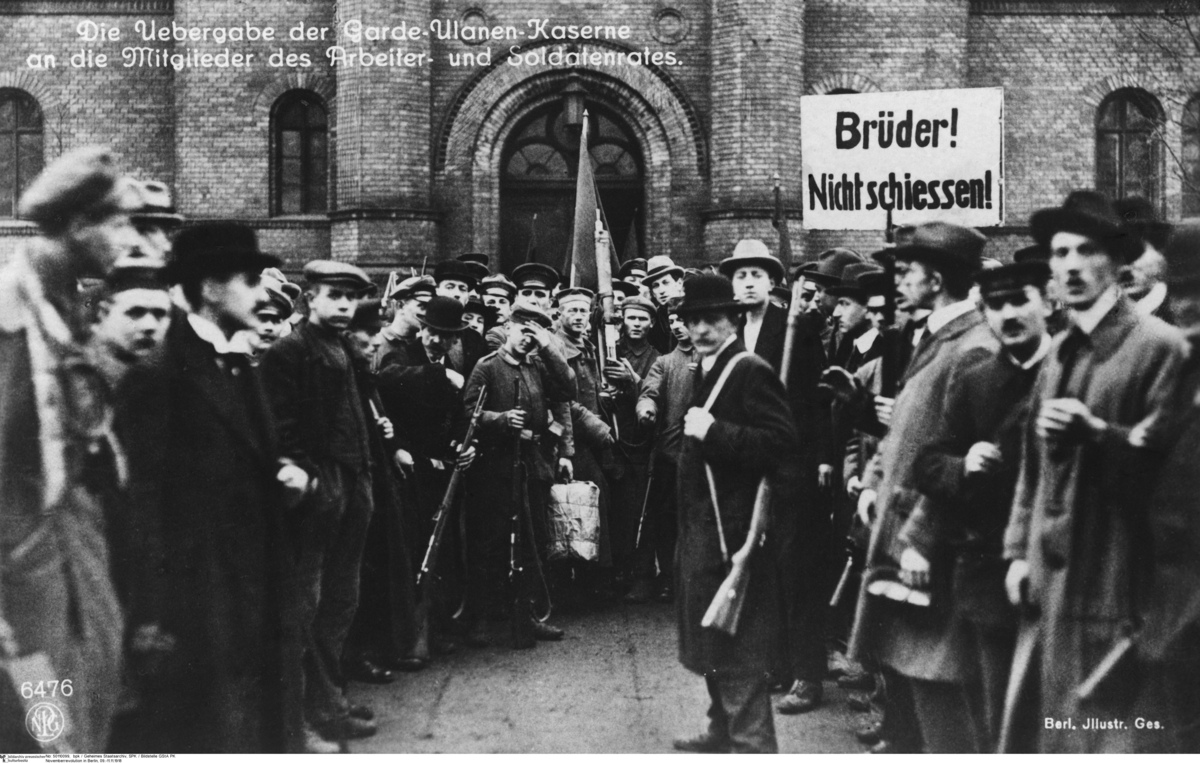
This photo postcard is captioned “The surrender of the Guards Uhlan
barracks to members of the workers’ and soldiers’ councils.” The image
shows armed soldiers and civilians in Potsdam at the entrance to the
barracks, which was handed over to the revolutionaries without a fight.
The revolution, which had begun in the military with sailors, soon also
spread to war-weary workers in Berlin and other German cities. The
workers’ and soldiers’ councils (aka soviets) that formed consequently
occupied public buildings and demanded both the Kaiser’s resignation and
the establishment of a democracy. During the mass protests in Berlin on
November 9, the revolutionaries announced their intention to proceed
without violence, using slogans such as “Brothers! Don’t shoot!” Given
the different political directions within the revolutionary movement,
the SPD leadership under Friedrich Ebert strove to prevent bloody
encounters in the street fights because it feared that the revolution
could escalate into a civil war. Above all, a fratricidal conflict
between democrats and socialists was to be avoided. Yet the beginnings
of such a conflict were already apparent when Karl Liebknecht proclaimed
a socialist republic on November 9th.